Thursday, December 23, 2010

The Etymology of 'Tariff' and 'Austerity'

. Thursday, December 23, 2010
0 comments

Thus, it seems the term "tariff" was first applied to designate the "rates," or duties which the Roman Catholic priests levied upon sins.


Via Simon Lester, more here. It comes from the Arabic d'araf, meaning "to know".

As for 'austerity', this article gives the run-down on Merriam-Webster's 2010 Word of the Year, and includes some quotes from IPE prof (at Brown) Mark Blyth (who is researching a book on the topic). We covered Blyth, and a video preview of his book, previously.

The High Politics of ROK/DPRK Trade

.
0 comments


It is hurting:

Inter-Korean trade has fallen about 30 percent this year, largely affected by South Korea's move to cut almost all business relations with North Korea after the North sank one of its naval ships in a torpedo attack in March, the customs office said Wednesday.


This is to be expected. But this surprised me:

According to data provided by the Korea Customs Service (KCS), trade between the two Koreas amounted to US$464 million during the January-November period, down from $649 million recorded a year earlier.


That is more trade than I thought. North Korea's GDP is ~ $27bn, so that $650mn in trade represents about 4% of DPRK GDP*. To put that in perspective, in 2009 the U.S. and China traded $366bn in goods, or about 3.8% of (U.S.) GDP.

Perhaps that plays into why the DPRK backed down earlier this week: they literally can't afford to keep playing high stakes poker when they're so short-stacked. As any poker player knows, "in a heads-up game, the size of your stacks is as important as the cards in your hand". The ROK is in a position to lean on the DPRK, the DPRK doesn't have a bankroll to fall back on, and both know it. Especially because much more than just $650mn is at stake:

Despite such a sharp shrinkage, trade through the Kaesong industrial complex, tallied in a separate statistic, remained robust. Trade amounted to $1.31 billion during the 11-month period, up 62 percent from a year earlier. ...

South Korea is the North's second-largest trade partner after China. A suspension of inter-Korean business would significantly impact the reclusive communist nation's efforts to secure cash, according to experts.


Long and short: the ROK can trade with the U.S., Japan, and everyone else in the world. The DPRK can't. There's an important asymmetry here that the ROK can, and apparently is, using to its advantage.

*To be clear, that $650mn is not entirely on the North's end. It's total trade. But the North exports more to the South than vice versa, and is definitely more dependent on that trade. From the article:

South Korea's exports to the North came to $130 million during the cited period, down 28 percent a year earlier, while imports dropped 29 percent on-year to $334 million, the data showed.


Via.

Wednesday, December 22, 2010

Interesting US-China Trade Developments

. Wednesday, December 22, 2010
0 comments

I don't have a whole lot to say about this, except that whenever we discuss increasing the amount of research for green technologies, or consider subsidizing production or consumption of green energy, we almost never consider the fact that those policy tools often violate international trade law. That's not the purpose of this suit, which is intended to protect American steelworkers (again), but it is a very real implication.

I also found this interesting:

The United Steelworkers, which had protested the Chinese wind power fund as part of a larger, 5,800-page trade complaint it filed with the American government on Sept. 9, said the administration’s decision was only a first step in addressing a “vast web of protectionist policies” by Beijing.


5,800 pages? From just one union? Geez.

Here's the statement from the US Trade Representative.

Here's a strong claim (via IELPB) about the misleading way trade statistics are calculated:

A new reasearch paper calculates that because of the way trade statistics are calculated - the full value of an iPhone is considered an export to the U.S. from China by both countries, even though only about 1% of the value was created during the final assembly process in China - just the iPhone alone added almost $2 billion to America's trade deficit with China in 2009. The authors find that if a "value-added approach" was used to calculate trade statistics, the iPhone would have instead generated a $48 million trade surplus for the U.S. in 2009, instead of the $1.9 billion trade deficit reported using the conventional methodology. ...

[I]f trade statistics were adjusted to reflect the actual value contributed to a product by different countries, the size of the U.S. trade deficit with China—$226.88 billion, according to U.S. figures—would be cut in half.


I wouldn't worry so much about the actual numbers, and instead focus on the fact that the trade statistics, like many other common statistics, do not always do a good job of measuring what they are supposed to measure.

IPE Everywhere: Soliciting Capital in Macedonia

.
0 comments


(ht: Besir Ceka)

Tuesday, December 21, 2010

Iceland Is Not A Good Example For Running An Economy

. Tuesday, December 21, 2010
0 comments


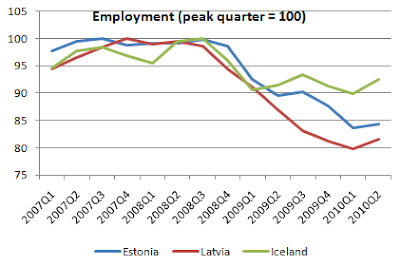
Krugman posts the above graphic showing GDP declines in the Baltics as compared to Iceland. He uses it to argue that the Baltics, which chose internal devaluation rather than sacrifice their exchange rate pegs to the Euro, did much worse than Iceland, which had no currency peg to defend, and so devalued their currency rather than their internal economy. The below picture, covering roughly the same time period, shows this:


Ignore that sharp downward tick at the end and what you see is that the krona fell by roughly half against the euro from the end of 2007 to its 2009-2010 levels, which then stayed fairly constant. To which Krugman says:

Now it’s true that the Baltic countries have been able to maintain their fixed exchange rates. And this is crucial because ….?


I'm not sure if "crucial" is the right word, but a 50% currency devaluation hurts a small open economy like Iceland quite a lot. Before the crisis Iceland mostly produced two goods: fish and finance. It imported almost everything else, and many of those imports came from the eurozone. When its currency dropped in value by 50%, that means that those imports became 100% more expensive. This represents a huge drop in standards of living.

Krugman approvingly references this IMF report on Iceland, noting:

Iceland, as even the IMF says, has been able to “preserve the Nordic social model”; there has been a lot of distress, but not much extreme hardship.


Yes, but according to that report Iceland has only been able to preserve the Nordic social model by exploding sovereign debt from under 30% of GDP pre-crisis to over 115% of GDP now. Of course, servicing that debt becomes much more expensive when the krona is devalued. The IMF also suggests that to get its fiscal house in order Iceland will need to go on its own austerity program to run a 6% of GDP primary surplus over the medium-run. Also note that the Icesave situation has not been resolved; Iceland may yet need to redistribute funds to depositors in Britain and the Netherlands. This will be much more expensive with a devalued currency, but Iceland's IMF funding is contingent upon reaching an agreement.

None of this is to say that the Baltics have had it any better. Output and employment losses have indeed been more severe there, partially because they kept their exchange rate pegs, but also because they are just generally not as well developed politically or economically as Iceland (a member of the OECD with strong economic ties to Europe's center, remember). The point is that these crises are just not easily resolved. The choice between internal devaluation and currency devaluation is not simple for small open economies. Both involve major reductions in standards of living, even if only one of them shows up in the GDP statistics.

Monday, December 20, 2010

Postwar Macroeconomics

. Monday, December 20, 2010
0 comments

Seems we're the last to jump on the Ngram bandwagon.


On DADT Repeal

.
0 comments

For those who prefer analysis to tropes, here's a nice rundown (via Stephen Walt) of the research on the effects of allowing gays to serve openly in the military. They survey the experience of other countries, as well as the U.S. military's own studies. Short version: almost no bad effects excepting (very minor) short-run disruptions from implementing the policy, and many positive benefits beyond that.

None of the above would have to be true for me to support DADT repeal -- the best argument is the one that invokes justice and liberty -- but it's always nice when empirical facts appear to line up with my normative preferences.

As a side note, I've always found the (only) case against DADT repeal -- that it would adversely affect unit cohesion and morale, which apparently is the greatest end of modern society -- to be immensely insulting to the troops. It's basically saying that our servicemen and women are so immature that they can't deal with a situation that college kids in dorms manage every day. It's profoundly disrespectful to say such a thing to those we ask to kill and die on our behalf, and I have enough regard for them to think that notion is ridiculous.

And that's to say nothing about the disrespect shown to those who wish to serve openly, but are told that they would weaken the military by their very presence.

In fact, the studies cited in the Palm Center's report say the opposite is true: a policy whereby gays cannot serve openly weakens cohesion and morale, perhaps by breeding suspicion and ostracization of those believed to be gay (whether they are or not), and by preventing gay people that serve while in the closet to fully assimilate into the group. This should have been obvious to anyone who has thought about it for more than 3 seconds.

I try not to get on my high horse too often on this blog, but DADT was a terrible policy in every respect. Good riddance.

Korea

.
0 comments

When I went to bed last night the news sites were all saying that a resumption of the conflict on the Korean peninsula was possible -- even "imminent" according to one source -- if the South proceeded with its plans to hold a military exercise in disputed territory. I went to bed thinking that I'd wake up to no news, which would certainly be good news. That turns out to have been right, so here's some thoughts on the situation.

1. The security dilemma is still the most important concept in international relations. Obviously the South is spooked by the North's nukes and occasional belligerence, and felt the need to demonstrate its defensive capabilities. The North is obviously spooked by the fact that a huge, well-funded military backed by (still) the only global superpower is right below it, and it can't necessarily count on its only ally (China) for much support.

2. Schelling is still boss. He first identified the "cliff-dancing" strategy in his 1960 book, and it is still relevant. The South just danced a bit closer to the brink, and it worked.

3. North Korea is very weak, but it is not crazy. Neither impression is the one Kim Jong Il wishes to leave, but that conclusion is inescapable at this point. The North threatened retaliation if the South conducted this exercise, but immediately back-tracked since those threats were clearly not credible. In fact, it appears that once its bluff was called it was willing to do quite a lot to walk back its earlier threats. It offered possibly-meaningful concessions in negotiations with Bill Richardson, including resumption of the six party talks, access to its nuclear facilities by outside inspectors, and the return of the remains of U.S. soldiers that died during the Korean War. I'm not at all suggesting that the South should continue to posture in this way, but in this case it appears to have worked.

4. Nukes only get you so much deterrence capability. Namely, they can (perhaps) act as a repellent, but cannot compel others to

5. For all of the talk about shifting power structures in Asia, the U.S. and its ally still won the day. Not just by holding the exercise without retaliation, which was sort of a "remind them who's boss" maneuver, but also by the response of the other regional powers. China and Russia implored the South to stand down, to no avail, indicating a clear lack of power and influence in the region. This follows the U.S.'s decision to conduct joint exercises with South Korea last month, a move China opposed because it occurred in China's "exclusive economic zone" but did nothing to prevent.

6. This incident is really the first time the Obama administration has been willing to stare down some of the U.S.'s antagonists, and he won: the other side blinked (DPRK) or sat down (China). Not only the military exercises, which not only involved moving the USS George Washington strike group to the Yellow Sea, but also passed the ROK-US trade agreement. I'm not sure whether this will encourage more risk-taking by the administration or even whether it should, but it is notable.

7. Keep all of this in mind when you hear that Iran is crazy, undeterrable, will be able to marshall nuclear capabilities to blackmail the Middle East, etc. All of those ideas have been tested over the past month in Korea, and all of them have been found wanting.

UPDATE: Drezner also posted thoughts. I like his #4, but I don't buy it. I think #3 is more likely, and if true is a positive sign for the future of Asia.

Sunday, December 19, 2010

FOTD

. Sunday, December 19, 2010
0 comments

China is building its first aircraft carrier. As Yglesias says:

News that China may be in the midst of building its first aircraft carrier is a reminder both of China’s rising geopolitical clout and also the reminder that they remain quite a bit behind us.


"Quite a bit" is an understatement, of course.

Yglesias also points to this very good article by Rob Farley on why a U.S.-Japan-India coalition to balance against China may not be a good thing, even if its inevitable. It's gated for non-subscribers, but those with institutional IDs (i.e. students) should be able to get access.

Friday, December 17, 2010

Newsflash: IMF Is Nervous of Labor Parties

. Friday, December 17, 2010
1 comments

File this one under "obvious":

"The likely change in government in 2011 increases the political risks," that Ireland will not follow through on the deep budget cuts, bank restructuring and other measures promised to restore the economy, the report said in a section assessing the country's ability to repay IMF loans. ...

Still, the IMF said that the political risks to the program are "considerable," adding uncertainty to a process that has roiled European markets and heightened the sense of confusion around how the continent - and particularly the 16 nations that share the euro as a currency - will settle a long list of economic problems.


The thing to note here is that the Irish government did not originally want EU/IMF funds, and the opposition party still doesn't. If the Irish Labour Party wins next year's election, as it appears they will, then it seems likely that Ireland will renege on the agreement. And quite frankly they should. The Irish got a raw deal that is brazenly engineered to benefit European bankers over the populace. Ireland can point to Iceland's better-than-expected performance since it refused to guarantee its banking sector's debts and get better terms, or else boycott any deal, allow their banks to default, leave the Euro and devalue the currency, and try to recover that way. Either way, there is no reason to stick to the deal as it stands.

International Political Economy at the University of North Carolina
 

PageRank

SiteMeter

Technorati

Add to Technorati Favorites