Saturday, July 16, 2011

The Coming Unnecessary Disaster

. Saturday, July 16, 2011
0 comments

I've recently had a few people ask me what the big deal is about the debt ceiling. A little default couldn't be that big of deal, right? And who cares what the ratings agencies think? I've found it distressingly difficult to get across just how serious this is. So let's start with this excellent primer from Ezra Klein:

It all comes back to U.S. Treasury bonds, which are the foundation of almost all other financial products — the base of the global financial pyramid.

If the federal government’s borrowing costs rise, so will everyone else’s. Mortgages rates will jump, car loans will be harder to come by, universities won’t be able to float bonds, cities won’t be able to fund themselves.

Treasuries are supposed to set the rate of “riskless return” — the price of loaning someone money and knowing, with perfect certainty, that they’ll pay you back, with interest. So when lenders decide how much to charge, they start with the riskless rate and then add to it to cover the risk that you won’t pay them back, and the inconvenience of having to wait for you to pay them back.

It’s a practice called benchmarking, and it’s everywhere: in your mortgage, your credit card, your car payments, the loan you took out to hire three new employees at your business. It’s even common internationally. The fact that Brazilian loans tie themselves to the American government’s debt just shows the high esteem in which the world holds us.


The most basic financial pricing formulas, the ones you learn about in Finance 101 like CAPM and Black-Scholes, depend in large part on a riskless, liquid baseline financial asset, which has long been understood to be US Treasuries. In other words, if T-bills are no longer "riskless", then the value of basically every financial instrument in the world comes into question. As I've mentioned previously, a Treasury default will make current financial regulations, which rely on risk-weighting to determine capital requirements where Treasury debt has a 0% risk weight, more or less meaningless. And because all of this is networked together, it can lead to big problems.

“There’s a whole credit structure,” says Pete Davis, president of Davis Capital Investment Ideas. “Think of it as roads and bridges, but it’s finance, it’s all connected, and it’s all on top of Treasuries. . . . So when you shake the basis of it, everything on top of it shakes, too.”


Or let's put this another way. If you thought things were bad when investors became convinced that Lehman Brothers and AIG were not as safe as they'd thought, what do you think will happen when people think the same about the US government? This has the potential to be very devastating. Klein puts it well:

Running in the background of every day’s trading is the accumulated wisdom of an almost endless number of calculations: How much money does J.P. Morgan Chase have? How likely is Des Moines, Iowa, to pay its bills? What will interest rates be next year? How many people will buy homes in 2013?

These calculations undergo incremental updates almost constantly. That’s fine. Occasionally, they need to be dramatically updated. That’s manageable. But if they all need to be updated at once, and if no one really has the information to update them because Treasuries are suddenly unreliable? That’s catastrophe.


And it's a catastrophe that doesn't need to happen. The ratings agencies appear to be more spooked about the US political process than real pressures on sovereign debt. And for good reason. The US government can borrow for the next five years at negative real interest rates. Literally. Other people will pay us to take their money:


Moreover, unlike other countries the US can borrow -- again, at negative real interest rates -- in its own currency. We don't have to worry about exchange rates or some technocrats in Frankfurt. This could be due to the dynamics I discussed earlier, in which there appears to be a shortage in high-quality investment assets. Regardless of the cause, we are flirting with a disaster the severity of which very few people seem to understand for no good reason at all.

The Bond Vigilantes are no longer invisible... they're just in the form of ratings agencies rather than bond markets. And we need to take them seriously. There's a reason why other countries are trying everything, including dispatching riot police to combat thousands of protesters, in order to avoid default. It's a very bad thing. It's a big mistake to treat it so flippantly.

We're Missing A Mechanism

.
2 comments

Felix Salmon:

The big-picture thing to remember when looking at this chart is something which I’ve said many times before — that it wasn’t an excess of greed and speculation which led to the financial crisis, but rather an excess of overcaution, with an attendant surge in demand for triple-A-rated bonds. On a micro level, triple-A securities are safer than any other securities. But on a macro level, they’re much more dangerous, precisely because they’re considered risk-free. They breed complacency and regulatory arbitrage, and they are a key ingredient in the cause of all big crises, which is leverage.


Much more at the link including the mentioned chart. Brad DeLong has made similar points in the past, and Tyler Cowen links to related discussion of how demand for AAA assets shifted to sovereign debt when it became clear that much AAA-rated ABS wasn't in fact AAA. Now of course there is a lot of trouble with sovereigns.

What we don't have a clear sense of is the mechanisms driving all of this. Is it a global movement towards safety beginning in the 1990s? Is it regulatory response, since both high-quality securities and OECD sovereign debt are privileged in the Basel accords?

From an IPE perspective, there appears to be insufficient supply of risk-free assets, which the US Treasury used to be able to provide. Unfortunately, the debt ceiling political theater has reduced that capability, which could have an adverse effect on the global economy and financial, not just the US economy and financial system. I'm very nervous about the state of the world right now.

Thursday, July 14, 2011

Politics of Default for the Cynical

. Thursday, July 14, 2011
0 comments

John Sides Joshua Tucker has a post on whether political science literature would/could predict that the Republicans would intentionally sabotage the economy in order to increase the chances that Obama loses the 2012 election. It's a fine discussion, but I'd like to add a few things related to the whole idea of economic voting, while acknowledging that this is not my area of expertise so it could all be wrong.

1. There's a fundamental assumption embedded in the economic voting literature that representatives are trying to manage the economy well, or at least well enough. When one party fails at that task, voters give another party a turn. In a situation in which the opposite is happening -- in which one party is openly trying to destroy the economy while the other is trying to save it -- the economic voting literature gives no reason to expect voters to reward the saboteurs. It violates the most core assumption of the basic model, which is that voters reward good governance (or at least good outcomes that are attributed to good governance). Tucker kind of gets at this in his last paragraph, but fails to drive home the point.

2. This may depend on how obvious the sabotage strategy is, and the particular frames voters use to interpret it. In this case I think it's pretty obvious. If Congress doesn't raise the debt limit, and the economy collapses, it'll be hard for Republicans to run and hide. McConnell's quote that his #1 task was to defeat Obama in 2012 rather than govern well will be in every Democratic advert. Cantor's short position on US debt will be shouted from the rooftops, and possibly investigated. Limbaugh's quote that he hopes Obama fails would be oft-repeated. Obama can say "I wanted to keep the Social Security checks flowing, I wanted to to not blow up the financial system and increase the costs of servicing our debt, but the GOP Congress wouldn't pass a bill allowing me to do it."

3. As Tucker says, many interest groups in the GOP camp are opposed to a shutdown/default. If the Chamber of Commerce and American Bankers Association as well as every economist in the world tell the GOP leadership that default is a bad idea, and the GOP goes against them anyway, well then that could be explosive.

4. This is where the McConnell gambit comes in. The GOP may decide that kicking the can down the road, with plausible deniability ("we voted against it!"), might be their best strategy. Obama opposes this strategy. Neither Obama nor the GOP is acting like a shutdown/default -- as opposed to signaling and theater -- is in the best interests of the GOP.

5. Tucker cites the Clinton shutdown in 1995 as Tucker's co-blogger John Sides has done before, but I think a few things need to be said about that. For one thing, the economy is in a very different place. For another, while Sides has presented evidence that the shutdown didn't benefit Clinton (see the graph at the link) what I see from that time series is a relatively minor downtick in Clinton's approval that quickly reversed after the shutdown ended, after which his approval continued to grow leading up to the election. To the extent that the Republicans are less concerned about Obama's approval in August, 2011 than November, 2012, Sides' previous analysis doesn't tell us all that much. In 1996 Clinton won re-election easily, while the House GOP lost some seats. That isn't proof of anything, but while the shutdown might not have helped Clinton it doesn't seem to have hurt him either. It certainly doesn't seem to have helped Gingrich or Dole.

Update: I got posts by Tucker and Sides confused. I think they're straightened out now.

More on US Manufacturing and Productivity

.
0 comments

Continuing the discussion from here and here (see comments) of US productivity, manufacturing capacity/activity, and what that means for both the domestic and global economy, David Steinberg pointed out that while total US manufacturing output has gone up, and US share of global manufacturing output has stayed surprisingly high, there's something else to consider:

I agree that the US's share of global manufactured production is the relevant measure regarding American control over global production. But, from what I can tell, the main reason why most people worry about the decline of manufacturing is the belief that the manufacturing sector has higher productivity than services (e.g. Rodrik's stuff). And if that is what worries you, then the manufacturing sector's share of GDP is the "better" measure. Maybe that's just my bias though.


If the worry is about productivity, then the data we're looking at should encourage us. After all, it shows that we're producing a lot more with a lot fewer workers... that's the definition of a productivity increase. But, as Steinberg says, we could be beneath our potential if we aren't using our workers in the most productive mixes. So take a look at this chart:


From the BLS via the Fed, which has a nice interactive tool at the link allowing you to compare sectors. I'm guessing the straight line for manufacturing pre-1986 means that these type of data weren't collected before then by the BLS, but in case the trend is pretty clear. Per-worker output has been going up for both manufacturing workers and those in services. Manufacturing productivity has risen fastest, which is I think part of what Steinberg is referring to (via Rodrik) but it's not clear that productivity in those industries is much higher than in non-manufacturing industries. Productivity growth has been faster there, but remember that we've been shedding workers during this period; those are likely the least productive workers. It's not immediately obvious that we could add a bunch more workers to that sector and keep productivity levels the same. There's some evidence and argument that quite a lot of these potential manufacturing workers generate very low marginal product. Meanwhile the marginal cost of hiring them remains relatively high. Automating a lot of simple tasks has made some workers's skills surplus to requirements, and offshoring to lower marginal cost workers for low-productivity tasks has further hurt those with few skills.

One (possible) way to think of these dynamics is as follows: the US economy is left with a high-skills, high-productivity economy in tradable industries. Those with lower skills get pushed into non-tradable sectors that are not easily automated, where their lack of productivity doesn't make them uncompetitive. Maybe that's okay if there are lots of jobs in construction or services, but it tamps down middle class wage growth while boosting high-skill wage growth, thus leading to more inequality.

If this is close to true, then we ought to see some political organization across sectoral lines, and some across factoral lines. Across sectors, we should see support for trade openness in nontradables and high-productivity sectors. Across factors, we ought to see a lot of opposition to immigration of low-skill workers from workers in nontradable sectors, but support for immigration for capital in those sectors. We should see more of the economy shift to high-skill services. We might expect a stronger social safety net too. To greater or lesser extent all of those have been present in the politics of the US over the past 10-15 years.

Has there been any research done on the politics of productivity?

Wednesday, July 13, 2011

No One Could Have Predicted This

. Wednesday, July 13, 2011
3 comments

Today we see that banks are worried about their exposures to sovereign debt from Europe, especially now that Italy is wavering.

Yesterday, we saw that banks owned so much sovereign debt because it was well-rewarded in the regulatory code. Of course that happened because governments write the regulatory rules, and governments want to stack the deck to make sure they have access to plenty of cheap funds with which to fund spending programs. They do that by privileging sovereign debt in the regulatory requirements, specifically the risk-weights given to debt assets in the capital adequacy standards.

This is no surprise, but it's worth taking a step back every now and then to consider what's going on.

Would A Yuan Appreciation Narrow the Trade Imbalance?

.
0 comments

Probably not:

Moreover, the impact of higher dollar prices for Chinese goods might well be to raise the U.S. import bill. In particular, U.S. spending on Chinese goods would rise unless higher prices induced a proportionately larger decline in import volumes. For example, if a 10 percent rise in the price of Chinese products resulted in only a 7 percent decline in the volume purchased, spending would rise by roughly 3 percent. Significantly, empirical studies have been as likely to find that higher prices raise U.S. import spending as lower it. Regardless of the direction of the spending impact, these offsetting price and volume effects imply that the impact of a Chinese currency appreciation on U.S. import spending would be small.

Finally, the impact of a stronger renminbi on U.S. imports would be limited by the fact that most goods purchased from China come from industries in which U.S. producers no longer have a substantial presence. Indeed, out of more than 400 detailed production categories, 60 categories account for some 80 percent of U.S. purchases from China. The same 60 categories account for less than 15 percent of U.S. manufacturing shipments. With little U.S. capacity at the ready, higher Chinese import prices might be more likely to spur increased imports from Korea or Vietnam than increased U.S. production. If so, a smaller U.S. trade deficit with China would be offset by larger deficits with other countries.


The last point is key, I think. I'm not as concerned about the short-run elasticities as the long-run structural issues.

"Ohhh Buh-yam!" of the Day

.
0 comments

Stephen Williamson, on the Krugman-Cochrane rivalry:

It's likely that, in the absence of his Krugman-critique, Cochrane would never have appeared on Krugman's radar screen, much like the rest of the the economics profession or, indeed, economics in general. However, Cochrane now has a place of honor on Krugman's list of bad guys, and serves as a convenient foil, particularly given his University of Chicago affiliation.


I still think this is basically theater.

OT: Does Yadier Molina Hurt the Cardinals By Being Awesome?

.
1 comments

Note: While watching the All-Star game, I grabbed some data and wrote this post for Viva El Birdos, the best blog covering my favorite sports team, the St. Louis Cardinals. Since it's kinda-sorta rat choicey I thought I'd toss it up here too. Oh who am I kidding... I'm putting it here because I don't feel like writing another post tonight. If I thought hard enough I'm sure I could squeeze out some relevance for IPE, but I'm not going to bother. Skip it if you like.

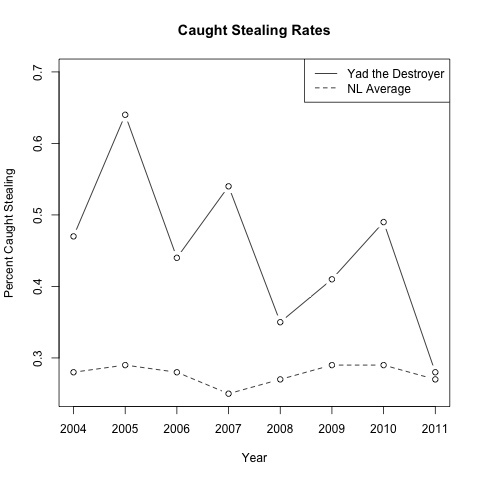
It's generally accepted that in terms of preventing other teams from stealing bases Yadier Molina is one of the best, if not the best, catchers in MLB. Al Hrabosky is fond of saying that Yadi is so good that teams just don't steal on him anymore (and Al's not the only one). Which always made me wonder... Given that base-stealers must be successful at least 75% of the time to benefit their team, is it really a good thing if Yadi's excellence at throwing out stealers prevents teams from running? After all, if teams ran on him more, he'd generate more outs. Perhaps it would be better for the team is Yadi was worse, thus generating more attempts, thus generating more outs.


I had a few hours to kill tonight, so I thought I'd plot some data, all of which comes from Baseball Reference. The first graph shows the percentage of would-be stealers that Yadi has caught in his career, as well as the National League average.


5932517742_433f4690e7_medium


As expected, Yadi has been very good over the course of his career, well better than the league average, although so far this year has been his worst. But has his success had an effect on other teams? In other words, do teams run on Yadi much less than other catchers? This next graph shows the stolen attempts for Yadi (per 162 games) compared to the NL average. (Formulas: (SB+CS)*(162/GP) for Yadi; ((SB/G)+(CS/G))*162 for NL.)


5932022455_40e272b66d_medium


Okay, so teams really don't run on Yadi: he routinely has 50-60 fewer attempts against than the NL average catcher -- or would have, if he played all 162 games. So Yadi has fewer attempts against but more outs per attempt than the average catcher. We might think that the team would benefit if we could maximize the number of outs made (so long as the percentage of caught stealing remains above 25%). How does this translate into outs over the course of a season? (Formulas: CS*(162/GP) for Yadi; (CS/G)*162 for NL. Again this is normalized as if Yadi played in every game.)


5932065015_f7e2f1cf10_medium


The answer is... there's not a huge effect, but Yadi's prodigious ability to catch potential base stealers probably doesn't help the team, and might even hurt it a bit. In four years (2004, 2008, 2009, 2011), Yadi generated fewer outs on the bases than the NL average. In two years (2007, 2010), he generated more. In two years (2005, 2006), he generated almost exactly the same. In no year is the difference all that large. For the stats-minded: I doubt the effect is statistically significant, but in this case a failure to reject the null hypothesis is very interesting, since it contradicts the Hrabosky-esque conventional wisdom. Obviously this is a crude analysis, but often simple stats are the most illustrative. 


The broader point that I'm interested in making is that baseball, like all games, is strategic. If a player is really, really good (or bad) at one thing, then other teams will respond by changing their approach to the game in order to neutralize that advantage. Think of NBA teams fouling Shaq intentionally to make him shoot free throws. Or MLB teams walking Barry Bonds 232 times (!) in 2004. In some cases, it might benefit the team if the individual player were a little bit worse, so that their opponents didn't focus so much attention on them. 


In other words, Yadi probably hasn't hurt the team with his cannon arm, at least not much. But he hasn't helped the team much either. It would probably be better for the team if he was slightly above average (say, 30-35% caught-stealing rate rather than 40-50%) but not enough for teams to drastically alter their base-running patterns. 

Tuesday, July 12, 2011

Why Doesn't Anybody Use Slopegraphs?

. Tuesday, July 12, 2011
0 comments

I'm going to start. This is a slopegraph, from Tufte (p. 158):


(click for bigger, less blurry, image)

Lot of information, conveyed elegantly and simply. Discussion here. R code here. Via Kottke.

US: Still a Global Leader in Manufacturing

.
6 comments

As part of a back-and-forth in comments to this post, LFC (of the excellent Howl at Pluto) wrote:

But on US mfg not having declined in raw terms: are you saying e.g. that roughly as much steel is produced today in Youngstown, Pittsburgh, etc. as was produced in, say, 1968, just with many fewer workers and fewer plants? That would surprise me.


Surprise!


Via. I'm not sure about steel in Youngstown per se, but overall the US manufactures more now than it ever has. As a percentage of global manufacturing output the US hasn't declined too much either. Until the subprime crisis/Great Recession the US had stayed around 25% of global manufacturing output since 1975.


Despite that downtick, the US was still the largest manufacturer in the world in 2009 (more graphs and discussion at that link). The view that the US just doesn't produce anything anymore is common, but it's wrong. We still produce quite a lot, in both raw terms and as a share of global output, and we do it with fewer workers than ever before. That's bad for the unneeded workers in the Rust Belt, but not for the broader economy.

International Political Economy at the University of North Carolina
 

PageRank

SiteMeter

Technorati

Add to Technorati Favorites