
Larger version here. Via Kottke, who points to the home site which is full of maps of stereotypes.

WatsonMedia presents Mark Blyth on Austerity from The Global Conversation on Vimeo.
The final payment of £59.5 million, writes off the crippling debt that was the price for one world war and laid the foundations for another.
Germany was forced to pay the reparations at the Treaty of Versailles in 1919 as compensation to the war-ravaged nations of Belgium and France and to pay the Allies some of the costs of waging what was then the bloodiest conflict in history, leaving nearly ten million soldiers dead. ...
"On Sunday the last bill is due and the First World War finally, financially at least, terminates for Germany," said Bild, the country's biggest selling newspaper.
Most of the money goes to private individuals, pension funds and corporations holding debenture bonds as agreed under the Treaty of Versailles, where Germany was made to sign the 'war guilt' clause, accepting blame for the war.
Basel III, we learned this weekend, is on course to raise capital requirements – but to a level below what US banks have held on average in recent decades (for Tier 1 capital, Basel III posits 8.5 percent at the end of the day; US banks fluctuate roughly around 10 percent).
Currently, the EU devotes 77 percent of its budget to agricultural subsidies and structural spending on physical infrastructure and the like.

The 3 inputs are as follows:
1. Department level data collected by the NRC on 20 different indicators (e.g., publications, citations, proportion of students who graduate within six years, etc.).
2. Survey data that asked respondents to evaluate how important each of the 20 indicators are to graduate program quality.
3. Survey data that asked respondents to rate a random subsample of 15 programs on a six point scale. ...
In the R rankings, the ratings in (3) are regressed on the indicators in (1) to generate a regression based set of weights. These weights were then applied to the indicators in (1) on the full set of schools to generate rankings. Since there is uncertainty in these rankings, the regressions were estimated 500 times on random half samples of respondents, which generates the percentile rankings.
Islam and Large-Scale Political Violence: Is There a Connection?
M. Steven Fish, Francesca R. Jensenius and Katherine E. Michel
Are Muslims especially prone to large-scale political violence? From Montesquieu to Samuel Huntington, prominent modern analysts of politics have regarded Muslims as unusually inclined to strife. Many other observers have portrayed Islam as a peace-loving faith and Muslims as largely pacific. Yet scholars still lack much hard evidence on whether a relationship between Islam and political violence really exists. Precious few studies adduce empirical evidence on whether Islamic societies are actually more or less violent. This article assesses whether Muslims are more prone to large-scale political violence than non-Muslims. The authors focus neither on terrorism nor on interstate war. Instead, they investigate large-scale intrastate violence. The article makes three contributions. First, it offers useful data on Islam and political strife. Second,it investigates whether Muslims are especially violence prone. Relying on cross-national analysis, the authors find no evidence of a correlation between the proportion of a country’s population that is made up of Muslims and deaths in episodes of large-scale political violence in the postwar period. Third, the authors investigate whether Islamism (the ideology), as opposed to Muslims (the people), is responsible for an inordinate share of the world’s large-scale political violence. They find that Islamism is implicated in an appreciable but not disproportionate amount of political violence.
The National Elections across Democracy and Autocracy (NELDA) dataset provides detailed information on all election events from 1960-2006. To be included, elections must be for a national executive figure, such as a president, or for a national legislative body, such as a parliament, legislature, constituent assembly, or other directly elected representative bodies. In order for an election to be included, voters must directly elect the person or persons appearing on the ballot to the national post in question. Voting must also be direct, or "by the people" in the sense that mass voting takes place. That voting is "by the people" does not imply anything about the extent of the franchise: some regimes may construe this to mean a small portion of the population. However, when voting takes place by committee, institution or a coterie, the "election" is not included. By-elections are not counted as elections for the purpose of this project, unless they take the form of midterm elections occurring within a pre-established schedule. In federal systems, only elections to national-level bodies are included. Cases in which any portion of the seats in a national legislative body are filled through voting are included.
Beyond these basic requirements, elections may or may not be competitive, and may have any number of other ostensible flaws. In fact, this last feature of the dataset is what separates NELDA most clearly from other available datasets on elections.

I have a plan that will raise wages, lower prices, increase the nation's stock of scientists and engineers, and maybe even create the next Google. Better yet, this plan won't cost the government a dime. In fact, it'll save money. A lot of money. ...
Here's the plan: More immigration. A pathway to legal status for undocumented immigrants. And a recognition that immigration policy is economic policy and needs to be thought of as such.
The mistake we make when thinking about the effect immigrants have on our wages, says Giovanni Peri, an economist at the University of California at Davis who has studied the issue extensively, is that we imagine an economy where the number of jobs is fixed. Then, if one immigrant comes in, he takes one of those jobs or forces a worker to accept a lower wage. But that's not how our economy works.
With more labor - particularly more labor of different kinds - the economy grows larger. It produces more stuff. There are more workers buying things, creating demand. That increases the total number of jobs. We understand perfectly well that Europe is in trouble because its low birth rates mean fewer workers - and that means less economic growth. We ourselves worry that we're not graduating enough scientists and engineers. But the economy doesn't care if it gets workers through birth rates or green cards.
A study by Harvard economists George Borjas and Lawrence Katzj found that although immigrants raised native wages overall, they slightly hurt the 8 percent of workers without a high school education. A subsequent study by Peri found that even unskilled workers saw a benefit from immigrants - but it was much smaller than that of highly skilled workers.
Over the past decades, the steel industry has been protected by a wide variety of trade policies, both tariff- and quota-based. We exploit this extensive heterogeneity in trade protection to examine the well-established theoretical literature predicting nonequivalent effects of tariffs and quotas on domestic firms’ market power. Robust to a variety of empirical specifications with U.S. Census data on the population of U.S. steel plants from 1967-2002, we find evidence for significant market power effects for binding quota-based protection, but not for tariff-based protection. There is only weak evidence that antidumping protection increases market power.
German workers are mobilizing to fight for a bigger share of the export-driven recovery, arguing that wage raises are necessary to spur consumer spending in Europe’s biggest economy, an IG Metall union leader said. ...
While exports give Germany a “very strong leg to stand on,” increases are justified because the recovery is at risk without consumer spending, Schwitzer said. “If you’re only standing on one leg, you start to limp,” she said. “The second leg, domestic spending, has to be strengthened.”
Pressure is building for pay raises in Germany after years of belt-tightening. The U.S. Treasury, the European Commission, French Finance Minister Christine Lagarde and billionaire investor George Soros have all urged Chancellor Angela Merkel’s government to bolster consumption and rely less on exports to aid recovery in Europe and globally. ...
The government should use its trade surplus, the European Union’s biggest, to “foster domestic demand and ease reliance on exports that are contributing a huge trade imbalance on the euro-zone’s periphery,” said Juergen Kroeger, a director in the EU Commission’s Economic and Financial Affairs department.
“Why aren’t we paying people higher wages in this country?” he said Sept. 13 in Berlin. “That might be a start.”
But my real question is this: if our primary goal is to discourage Iran from developing nuclear weapons, then might this new initiative be counter-productive? Doesn't it just give Iran an even bigger incentive to get a nuclear deterrent of its own? Think about it: if you had a bad relationship with the world's most powerful country, if you knew (or just suspected) that it was still backing anti-government forces in your country, if its president kept telling people that "all options were still on the table," and if that same powerful country were now about to sell billions of dollars of weapons to your neighbors, wouldn't you think seriously about obtaining some way to enhance your own security? And that's hard to do with purely conventional means, because your economy is a lot smaller and is already constrained by economic sanctions. Hmmm....so what are your other options.
Which leads me to the conclusion that a lot of what we’re seeing is a lack of genuine independence at the Fed, which became indistinguishable from Treasury during the crisis, and which has yet to break free from Treasury’s grasp.
The Federal Reserve broke a taboo yesterday when it said quite baldly that inflation in the US is now below the level “consistent with its mandate”. In other words, it is too low.
Kathleen Madigan points out that the language led to an immediate decline in the dollar, which should boost exports and, through rising import prices, inflation.
WASHINGTON—According to a poll released Tuesday, nearly 20 percent of U.S. citizens now believe Barack Obama is a cactus, the most Americans to identify the president as a water- retaining desert plant since he took office.
There currently are no broad-based sanctions in place against Iraq, but there are certain prohibitions and asset freezes against specific individuals and entities associated with the former Saddam Hussein regime, as well as parties determined to have committed, or to pose a significant risk of committing, an act of violence that has the purpose or effect of threatening the peace or stability of Iraq or the Government of Iraq or undermining efforts to promote economic reconstruction and political reform in Iraq or to provide humanitarian assistance to the Iraqi people.
Which leads me to the conclusion that a lot of what we’re seeing is a lack of genuine independence at the Fed, which became indistinguishable from Treasury during the crisis, and which has yet to break free from Treasury’s grasp.
But, frankly, Muslim life is cheap, most notably to Muslims. And among those Muslims led by the Imam Rauf there is hardly one who has raised a fuss about the routine and random bloodshed that defines their brotherhood. So, yes, I wonder whether I need honor these people and pretend that they are worthy of the privileges of the First Amendment which I have in my gut the sense that they will abuse.
The embarrassing sentence is: "I wonder whether I need honor these people and pretend they are worthy of the privileges of the First Amendment, which I have in my gut the sense that they will abuse." I wrote that, but I do not believe that. I do not think that any group or class of persons in the United States should be denied the protections of the First Amendment, not now, not ever. ...
The other sentence is: "Frankly, Muslim life is cheap, especially for Muslims." This is a statement of fact, not value. In his column, Kristof made this seem like a statement of bigotry. But on his blog, he notes that he concurs with it. "Peretz makes some points that are valid, and I agree with him that Muslims haven’t said nearly enough about those Muslims who kill other Muslims—in Kurdish areas, in Iraq, in Western Sahara, in Sudan, and so on."
The story was a whirlwind of spectacular "gets" which could only have been executed by a crack reporter on his best day, or an outright liar willing to invoke every odious stereotype from Steppin Fetchit to Bruce Lee to Willie Horton. ...
This is all about firepower. The fact is that Peretz has the social and economic guns to be a bigot, to then be defended by even those who acknowledge his bigotry, and finally be honored at the highest levels of American academia.
The idea for Glass’s breakthrough piece, “Taxis and the Meaning of Work” (published in August of 1996), came from New Republic owner Martin Peretz himself. Peretz had spoken frequently about how black taxi drivers in Washington were being replaced by cabbies from other immigrant groups; he thought it revealed something important about the attitudes of blacks toward certain kinds of work.
[T]his isn't about U.S. troops, or even about this particular group of U.S. troops. It's too easy to blame this on the type of people likely to be soldiers, or say that this is a group of bad apples. In the right situation, this could be me. This could be you.
War may bring out courage and heroism in the human heart, and many of us like celebrating that. And there's nothing wrong with celebrating valor. But war also brings out brutality and nihilism. And that is why we cannot go to war lightly, why if war is to be an option, it must be the last option, a desperate refuge that we flee to with a heavy heart.
Here is the argument of the film, in four sentences. From Roosevelt until Reagan, the American economy enjoyed 40 years of stability, prosperity and growth. Beginning with Reagan's moves against financial regulation, that sound base has been progressively eroded. The crucial federal error (in administrations of both parties) was to allow financial institutions to trade on their own behalf. Today many large trading banks are betting against their own customers.
Unlike Haiti, the Dominican Republic made a series of wise political and economic decisions. It didn’t cut down all its trees, it made the place safer to visit, and when it built up its economy, it focused on growth industries: drug trafficking, money laundering, and sex tourism. It’s impossible to take a photo in Santo Domingo that doesn’t involve a massive pair of breasts. I try, but the damned things are everywhere. ...
[A]fter living in Turkey, I’m just grateful to be around people who don’t seem driven enough to plot conspiracies or foment coups. I’m aware that the country has seen both, but it doesn’t seem plausible.


"This is what the corrupt regime's media has been reduced to," a statement on the group's website said. The state-owned press had "crossed the line from being balanced and honest," the statement continued.
President Nicolas Sarkozy of France vowed to keep dismantling illegal immigrant camps and rejected complaints that the French authorities were racist and deliberately targeted the Roma for deportation.
How should interest charges on goods in transit be computed when the goods travel at close to the speed of light? This is a problem because the time taken in transit will appear less to an observer traveling with the goods than to a stationary observer. A solution is derived from economic theory, and two useless but true theorems are proved.Krugman settles the question by laying out the "First Fundamental Theorem of Interstellar Trade":
When trade takes place between two planets in a common inertial timeframe, the interest cost on goods in transit should be calculated using time measured by clocks in the common time frame and not by clocks in the frames of trading spacecraft.
The day before I left Greece the Greek Parliament debated and voted on a bill to raise the retirement age, reduce government pensions, and otherwise reduce the spoils of public-sector life. (“I’m all for reducing the number of public-sector employees,” an I.M.F. investigator had said to me. “But how do you do that if you don’t know how many there are to start with?”) Prime Minister Papandreou presented this bill, as he has presented everything since he discovered the hole in the books, not as his own idea but as a non-negotiable demand of the I.M.F. The general idea seems to be that while the Greek people will never listen to any internal call for sacrifice they might listen to calls from outside. That is, they no longer really even want to govern themselves.
Are some things still worth dying for? Is the American idea one such thing? Are you up for a thought experiment? What if we chose to regard the 2,973 innocents killed in the atrocities of 9/11 not as victims but as democratic martyrs, “sacrifices on the altar of freedom”? In other words, what if we decided that a certain baseline vulnerability to terrorism is part of the price of the American idea? And, thus, that ours is a generation of Americans called to make great sacrifices in order to preserve our democratic way of life—sacrifices not just of our soldiers and money but of our personal safety and comfort?
In still other words, what if we chose to accept the fact that every few years, despite all reasonable precautions, some hundreds or thousands of us may die in the sort of ghastly terrorist attack that a democratic republic cannot 100-percent protect itself from without subverting the very principles that make it worth protecting?
Is this thought experiment monstrous? Would it be monstrous to refer to the 40,000-plus domestic highway deaths we accept each year because the mobility and autonomy of the car are evidently worth that high price? Is monstrousness why no serious public figure now will speak of the delusory trade-off of liberty for safety that Ben Franklin warned about more than 200 years ago? What exactly has changed between Franklin’s time and ours? Why now can we not have a serious national conversation about sacrifice, the inevitability of sacrifice—either of (a) some portion of safety or (b) some portion of the rights and protections that make the American idea so incalculably precious?
In the absence of such a conversation, can we trust our elected leaders to value and protect the American idea as they act to secure the homeland? What are the effects on the American idea of Guantánamo, Abu Ghraib, PATRIOT Acts I and II, warrantless surveillance, Executive Order 13233, corporate contractors performing military functions, the Military Commissions Act, NSPD 51, etc., etc.? Assume for a moment that some of these measures really have helped make our persons and property safer—are they worth it? Where and when was the public debate on whether they’re worth it? Was there no such debate because we’re not capable of having or demanding one? Why not? Have we actually become so selfish and scared that we don’t even want to consider whether some things trump safety? What kind of future does that augur?
Kindred Winecoff, for one, thinks that it’s hopeless to even dream that it might become reality.
It isn't an accident that the firms screaming bloody murder about Basel III are in Germany and Japan, not the U.S. and U.K. That's not to say that U.S. and U.K. banks love it, and they're certainly not going to say it, but Basel III isn't cutting into them as much as some of their foreign competitors.
Big US banks should be able to meet tighter global capital requirements without having to raise substantial amounts of new equity, according to calculations by Barclays Capital. ...
BarCap, for example, estimates that the 35 largest US bank holding companies will need to come up with $115bn in new equity or retained earnings to bring the ratio of their equity tier one capital to risk-weighted assets – a key measure of financial strength – to 8 per cent under the revised rules.
That is about half the $225bn in new capital the biggest US banks would have had to raise under a tougher draft of the rules circulated in December, said BarCap’s Tom McGuire, whose unit did the calculations.
Similarly, Nomura analyst Jon Peace calculated that the top 16 European banks would need to raise €200bn ($257bn) to restore capital removed by the reforms, down from €300bn under the December rules.
Germany’s top 10 banks will have to raise as much as €105bn ($135bn) of fresh capital under a global regulatory overhaul, the country’s banking industry has warned, in a last-ditch effort to change tough new rules. ...
The reforms are particularly contentious for German banks because public sector groups in particular have relied strongly on instruments called silent participations, which are not loss-absorbing, making them unsuitable as top-quality capital in the eyes of the Basel committee. ...
In July, when a draft was published, Germany was alone among the 27 countries represented in saying it could not agree to tighter definitions of capital without knowing what the headline ratios would be.
Japanese banks are particularly unhappy that under Basel III, deferred-tax assets would no longer be able to count as Tier 1 capital. ...
The tax deferral tactic started losing favor after Resona bank had to be nationalized in 2003 when its auditor wouldn't sign off on tax deferrals and its capital adequacy fell too low. Still, in 2008 roughly 100 banks counted as assets tax deferrals equal to 20% or more of their core capital, according to a Bank of Japan survey last September. The numbers had been rising for two consecutive years. In the U.S., by comparison, the Fed lets banks count the lower of either tax deferrals realized in one year or 10% of core capital.
A bigger factor, though, may be that Japanese banks have so much trouble raising any other kind of capital. Retained earnings are out because their profits are among the lowest in the world on either a return-on-equity or return-on-assets basis, according to a Bank of Japan report last month.
"The Cuban model doesn't even work for us anymore," [Castro] said.
In other words, Cuba is beginning to adopt the sort of economic ideas that America has long-demanded it adopt, but Americans are not allowed to participate in this free-market experiment because of our government's hypocritical and stupidly self-defeating embargo policy.
Garcia called over one of the aquarium's veterinarians to help answer the question. Her name was Celia. A few minutes later, Antonio Castro told me her last name: Guevara.
"You're Che's daughter?" I asked.
"Yes," she said.
I found myself agreeing with Fidel: The aquarium in Havana puts on a fantastic dolphin show, the best I've ever seen, and as the father of three children, I've seen a lot of dolphin shows. I will also say this: I've never seen someone enjoy a dolphin show as much as Fidel Castro enjoyed the dolphin show.
"This was how my face looked when I was angry with Khruschev," he said.
I asked him, "At a certain point it seemed logical for you to recommend that the Soviets bomb the U.S. Does what you recommended still seem logical now?" He answered: "After I've seen what I've seen, and knowing what I know now, it wasn't worth it all."
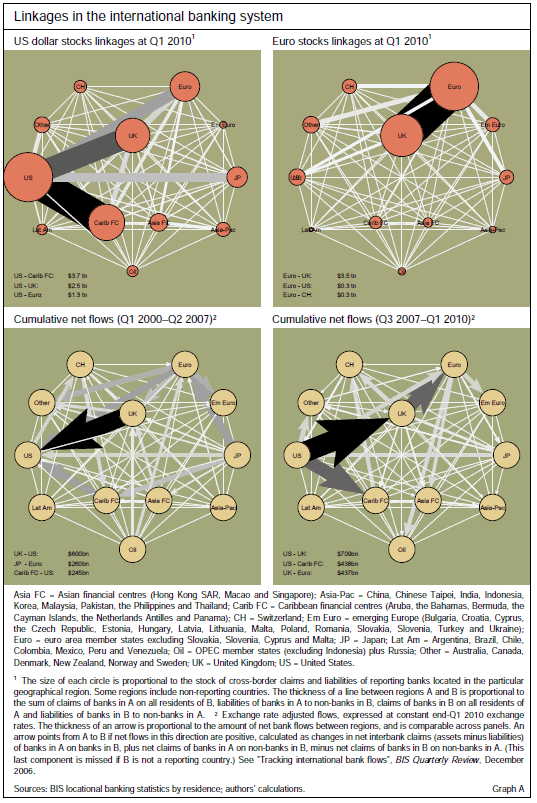
And while the emerging markets are no strangers to banking crises, the fact is that the most dangerous such crises are always the ones which take place in large, mature economies.
That’s where regulators — by which I mean the Bank for International Settlements, in Basel — have to step in, by forcing all countries to adopt a bare minimum capital requirement which will protect the system in two main ways: it will make bank failures less likely and less frequent, and it will improve the ability of the rest of the system to withstand any bank failure which does still occur.
Five gunmen attacked an American military convoy south of Baghdad. The troops were not "combat troops," so they used return fire to advise the attackers to die.
"Most of the articles that have appeared in the Review since its inception in 1906 have rarely if ever been cited...[B]y the end of 2005, some 155 Review articles had been cited 100 or more times, and one...had been cited more than 500 times...By comparison, more than twice as many articles in The American Sociology Review...had topped the 100 citations and a score had surpassed the 500 mark. This interdisciplinary difference, which is especially striking because political science is a much larger discipline than sociology, appears for the most part to be a manifestation of the attention that sociological research receives from outside of sociology--a phenomenon less apparent in political science. It is the very rare Review article that has become a standard point of reference or an object of encompassing interest for those in other disciplines, consistent with the image of political science as a "borrower" discipline theoretically and methodologically."*
The kinds of policy approaches that find support in the IR literature or can be usefully illuminated through it are just too far off the center of the American political consensus.
One reason that the field of economics plays a prominent role in popular discussions of politics is that you can find very credible academic economists with PhDs and everything on both sides of most of the big partisan battles in Washington. But that’s not really the case on the foreign policy side. The intellectual basis of modern-day rightwing foreign policy is DC think tanks and magazines and has nothing to do with scholarly controversies. This is a very very very bad thing for the world and leads us into some catastrophically misguided policy choices, and it also means that journalists attention tends to be focused on the bounds of the politicized DC debate which is unusually isolated from scholarly approaches to these topics.
@mattyglesias Really? No controversies in academic IR? No rightwing IR academics? No idea why you think that. It's just wrong.
@whinecough Lots of controversies in academic IR and I never said otherwise. But they don't map onto political controversies in DC.