Monday, November 7, 2011

Making a Mystery Where None Exists

. Monday, November 7, 2011
2 comments

Ryan Avent, at Free Exchange:

It is remarkable to me how readily old, successful professionals dismiss the labour-market difficulties of young adults as the product of their poorly-chosen majors and general lack of ambition, and on what flimsy evidence they're prepared to base these views. There are now 3.3m unemployed workers between the ages of 25 and 34. That's more than twice the level in 2007. There are over 2m unemployed college graduates of all ages; nearly three times the level of 2007. There are many millions more that are underemployed—unwillingly working less than full-time or unwillingly working in a job outside their field which pays less than jobs in their field. As far as I know, the distribution of college majors didn't swing dramatically from quantitative fields to art history over the past half decade.

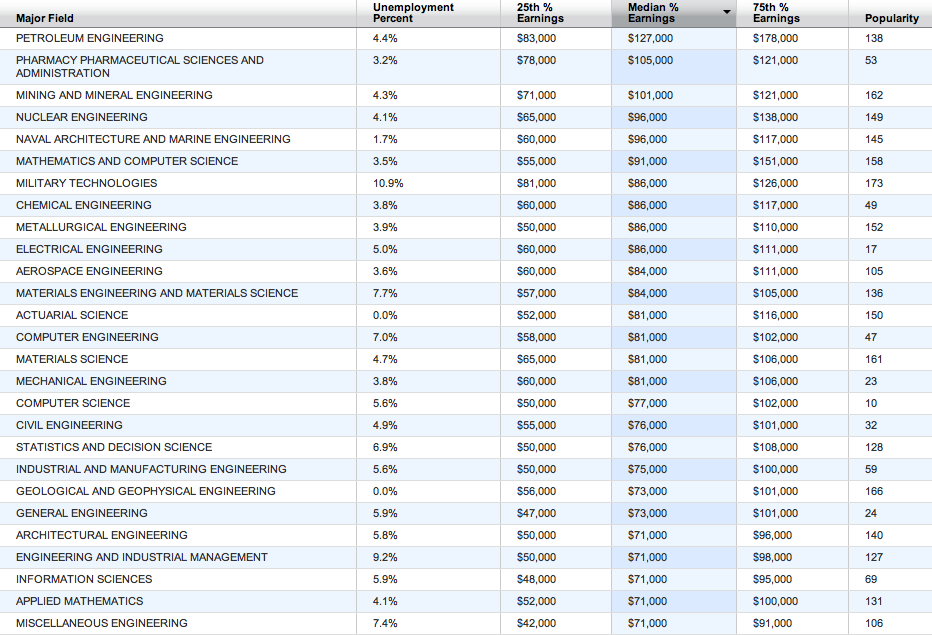
Meanwhile, the Wall Street Journal provides us with a handy interactive graphic examining unemployment rates by major according to the 2010 Census. Coming in toward the top of the list and ahead of "art history and criticism" are the sorts of degrees you'd expect, like those falling into "miscellaneous fine arts", but also "computer administration management and security", "engineering and industrial management", "international business", "electrical and mechanic repairs and technologies", "materials engineering and materials science", "genetics", "neuroscience", "biochemical sciences", and "computer engineering". I bet those graduates are all trying to break into puppetry!
Avent is correct that this recession has driven up unemployment among college graduates, but their rates of unemployment remain roughly half the national average, better than half the average of those with just high school degrees, and better than one-third of the average of those without a high school degree. (Those with postgraduate degrees are in even better shape.) Those with freshly-minted bachelor's degrees but little experience and few professional connections aren't doing as well those with many years in the professional world, as one would expect, but it still seems clear that having an advanced degree greatly enhances your ability to remain employed.

I agree that the WSJ's graphic is handy, but I see different things in it than Avent does. Here are the top professions by median wages (click for larger):


And here are those by lowest unemployment rate (click for larger):


There's a lot of quant degrees on both lists. The rest are mainly high-skill services. No humanities, no puppitry, no arts of any kind. (I'd guess that the low rates of unemployment -- albeit with fairly low wages -- in teaching and student counseling are related to the strength of those unions in the public sector, but I can't do any better than guess. And I'd wager that some of the surprisingly high rates of unemployment in some technical fields are related to educations that are out of date, but again that's just a guess.) Compare these charts to the data in this recent post by Alex Tabarrok and it seems pretty hard to deny that many students are not achieving degrees that give them an advantage in labor markets.


Friday, November 4, 2011

"You Can't Just Change the Rules Cuz You Don't Like the Outcome"

. Friday, November 4, 2011
1 comments


Terrific Office last night. After Andy gets scolded by Robert California for his mistake-prone staff, Dwight creates a doomsday machine (he calls it "an accountability booster"): if the staff make five mistakes in a day, an email that incriminates them all and recommends that the branch be closed gets sent automatically to Robert California. They all get fired and the Scranton branch closes. Of course, they spend more time trying to figure out whether it's just a scare tactic and on how to turn it off than they do working hard to avoid mistakes. Consequently, they trigger the five-mistake threshold.

Today I learn that legislators are considering how to prevent the automatic cuts in defense spending that are scheduled to take effect when the bipartisan Panel that is supposed to find some way to reduce the size of the budget deficit fails to reach such an agreement. Of course, the automatic cuts were never supposed to occur. Instead, the threat of the automatic cuts was supposed to be sufficient to force the Panel to make the adjustments necessary to avoid them. In other words, the automatic cuts are a doomsday machine. But, of course, Congress is getting scared that the Panel will fail, thereby triggering unwanted large cuts in defense spending. "Shut down the machine! Shut it down!" they now scream (watch the clip).  David Camp (R-Mich) recently begged Doug Elmendorf of the CBO to reassure him that nothing prevented Congress from "changing the mechanism for automatic cuts." Elmendorf reassured Camp, "Any Congress can reverse the actions of a previous Congress."

To restate Elmendorf's point: Congress can't commit itself. Most members recognize this. As Representative  K. Michael Conaway, Republican of Texas and a member of the House Armed Services Committee, noted, "If the joint select committee does not do what it needs to do, most of us will move heaven and earth to find an alternative that prevents a sequester from happening.” So, the threat of automatic cuts isn't credible. And because the threat isn't credible, the Panel isn't really under much pressure to find some way to cut the deficit by $1.2 trillion. As a result, maybe we shouldn't really expect the Panel to find a way to cut $1.2 trillion from the deficit because they bear no short run cost for failing to do so. Oh wait, the Times says they'll be embarrassed.

Spoiler alert: In the end, Dwight shuts down his doomsday machine. Turns out that even Dwight has time inconsistent preferences. His desire to be liked by the staff over-rides his desire to force the staff to improve by holding them accountable. The problem, of course, is that because Dwight shuts down the machine the staff will continue to screw up, and thus move inexorably closer to losing their jobs anyway. Maybe there's a lesson in there somewhere for Congress.

Thursday, November 3, 2011

The Rents Are Too Damn High QOTD

. Thursday, November 3, 2011
1 comments

From a long, excellent post by Ashwin Parameswaran at Macroeconomic Resilience. Please read the whole thing, as I expect it will be discussed a lot in the blogosphere over the next few days:

It is not the absence of rents but the continuous threat to the survival of the incumbent rent-earner that defines a truly vibrant capitalist economy.
This, in a nutshell, encapsulates much of the disagreement between Marx and Schumpeter: the former saw this threat as decreasing over time, while the latter saw it increasing. Perhaps one way to read the post-WWII economy is that Schumpeter is right over longer time horizons, but that the process is prone to fits and starts. In the shorter run Marx may well have the better hand.

Parameswaran goes on to link this to the Great Stagnation, theories of unemployment, Minsky, Keynesian/post-Keynesian macro, and much else besides. I'll be pondering this post for a long time.

Wednesday, November 2, 2011

There Is No Technocracy QOTD

. Wednesday, November 2, 2011
1 comments

Felix Salmon nails it in a post titled "All bank regulators are captured":

The fact of the matter, however, is that all regulators are captured by banks. Or, to be a little more precise, all legislatures are captured by banks, and all regulators do what the government tells them to do. 
In countries like Canada and India, there’s a very small number of strong, well-capitalized banks with a vested interest in maximizing barriers to entry. So they’re happy with very tough standards. In Europe, national banking systems are also concentrated, so in theory they could go the same way. But European banks are more likely to have cross-border and global ambitions, and in any case as a matter of contingent fact they’re not very well capitalized. So they get the regulation they want — which allows them to grow fast without having to raise lots of expensive new equity capital.

And then there’s the US, which is pretty much unique among major economies in having thousands of pretty vibrant small banks. Those small banks have a lot of political clout in Congress, and they hated Basel II, because they’re not nearly sophisticated enough to take advantage of it. So they essentially bullied Congress into keeping the old Basel I standards, for fear that otherwise they would be at a massive competitive disadvantage with respect to the big US banks like JP Morgan Chase. Congress obliged, and used the FDIC as its chosen mechanism for blocking the adoption of Basel II in the US.  

Does that make the FDIC particularly virtuous? No: it makes the FDIC just as beholden to the banks as any European regulator. Look at the banks’ contributions to the FDIC insurance fund, for instance: they fell to zero, for no good reason, just because the banks didn’t like making those payments.
Cross-national differences in regulations are not due to one country's regulators being somehow wiser than the rest. It has to do with different organizations of domestic interests within (and across) countries. These lead to different policy outcomes.

Paul Krugman does not in a post titled "Crats, Maybe, But Not Much Techno":
But it’s more than that: these alleged technocrats have in fact systematically ignored both textbook macroeconomics and the lessons of history in favor of fantasies. The European Central Bank has placed its faith in the confidence fairy, while imagining that it can run policy in a way that has never worked in several centuries of central bank experience. Meanwhile, the European policy elite has simply wished away the clear evidence that the euro zone needs to make an adjustment that is virtually impossible unless inflation targets are raised.

The point is that I know technocrats, and these people aren’t — they’re faith healers who are making stuff up to suit their prejudices.
I contend that Paul Krugman does not know technocrats. He knows people who have different priorities than those he dislikes in the government and punditocracy. He claims that his side are the true technocrats -- untainted by avarice or bias -- because that gives them a moral authority that they would not otherwise have. But Krugman's preferred "technocrats" are just those who prioritize labor over capital, to use a short-hand, while those he decries have the opposite preference. As Salmon notes, capital generally wins, but in varying ways that reflect their varying preferences in disparate places.

"Textbook macroeconomics" presupposes a political system that is dedicated to the pursuit of utilitarian aims, a "socially optimal" mix of outcomes. But there is no universally agreed upon social optimum. There are only different, competing interest groups with different, competing preferences. Rousseau was wrong about this. There is no General Will, only the Sum of Private Wills. Some interests are narrower than others, as OWS has figured out, but that's really the only difference.


Monday, October 31, 2011

The Euro Bailout, Explained

. Monday, October 31, 2011
1 comments


Xtranormal has gotten passe, but it still has its uses. I thought this was a pretty good run-down of the new plan for the eurozone. I'm still very pessimistic.

Saturday, October 29, 2011

Fly the Flag

. Saturday, October 29, 2011
1 comments


I am very happy right now.

Friday, October 28, 2011

The Argentinian Euro Deal

. Friday, October 28, 2011
0 comments

Markets seemed to like it yesterday, not so much today. You can find news and discussion of the plan everywhere. I liked Salmon's takes here and here.

Like many others I'm skeptical that it will work. Interestingly enough I'm currently reading Paul Blustein's very good And the Money Kept Rolling In (and Out) about the IMF's relationship with Argentina around the turn of the millenium. The parallels between Argentina and Greece are striking -- I'm not the first to notice this -- but the parallels between the IMF and EU actions are also notable. Let's run down some of them.

1. At the time Argentina was on a convertibility system with the peso was pegged one-to-one to the US dollar. This is functionally very similar to the European common currency, where "Greek" euros are pegged one-to-one with "German" euros. Both systems were adopted for similar reasons: national authorities were not able to credibly commit to stable monetary policy, which led to a lot of economic volatility, investment risk, and concomitant slow growth. In both cases macroeconomic adjustment is impossible through the exchange rate, which leaves internal devaluation (i.e. austerity) and/or debt default as the only remaining options.

2. Both policies worked well for about a decade. Because of that, the Argentine and Greek governments were able to borrow at low interest rates. And because of that, governments were fairly casual about fiscal probity. While public deficits were not extreme, they were politically entrenched. When growth began to slow lower tax revenues led to a growing debt burden. Interest rate spreads widened as investors began to believe that both economies would not be able to grow fast enough to manage their debt. This, of course, can become a self-fulfilling prophecy. Both governments were voted out of office, both new governments instituted fiscal reforms. In both cases these were insufficient to close the budget gap. In both cases the cost of incurring new debt, or of servicing old debt, became prohibitive.

3. In Argentina, the IMF began disbursing relatively small amounts of money in the hope that external financing would reassure bond markets. In other words, the IMF hoped that it was a liquidity crunch, not a solvency crisis. In that situation a tie-over loan can buy time for the economy to get some growth back. The EU did the same thing with the introduction of the EFSF. But the underlying economic numbers didn't improve, and bond markets continued to believe that issue was over solvency, not liquidity.

4. Politics intervenes. In Argentina, the US (and other key IMF members) were hesitant to offer additional financing as they had done during the Tequila Crisis. In particular, John Taylor -- then at the Treasury Department -- didn't want to throw US funds into the pot. Neither did Glenn Hubbard of the CEA or Paul O'Neill, the Treasury Secretary. In Europe, many members were reticent to commit more funds. In both cases policymakers tried to figure out how to leverage already-appropriated funds to have a greater effect, but nobody bought it in either case. (Ken Rogoff, at the IMF during the Argentina crisis, quipped "After one strips out all the window dressing, there is no way to make $6 billion of liquidity worth more than $6 billion in liquidity. But there are many creative ways to make it less.")

5. Then come the "voluntary" private sector haircuts, coupled with additional public funds. These are intended to do a few things: extend the timeframe that indebted countries have to consolidate fiscally, reestablish growth, force the private sector to bear some of the costs of bailouts, and thus prevent default in a politically palatable way. In both cases the initial market reaction was positive, but in Argentina the effect was short-lived and I expect that to be the case with Greece as well. Barry Eichengreen described the Argentina situation thus: "The realization had dawned that the IMF package offered no magic formula for getting growth going again. And without growth, it is hard to see how political support for paying the foreign debt can be sustained." This sounds a lot like Greece, no?

6. A corollary of the private sector haircuts, as well as extended financing from international institutions, is that the country actually becomes more indebted rather than less. This happens in two ways. The private sector demands some form of compensation in exchange for voluntarily altering the terms of their debt contracts; and the new financing from international institutions also tacks onto the principle. Additionally, it's more difficult to default on IMF/EFSF loans than private sector loans. Given that the optimistic scenario is that this deal will reduce Greece's debt load to 120% of GDP, and the fact that the fundamental problems -- low growth + high debt in a fixed-currency system -- have not been resolved, there is little reason to be optimistic about the outcome.

Ultimately Argentina's internal adjustment plans were undermined by domestic politics. Voters simply got sick of extreme austerity and revolted. That meant a debt default and the abandonment of the convertibility system. It's hard not to imagine a similar scenario playing out in Greece in the coming months.

Even if it doesn't, there's still Spain and Italy looming over the horizon.


UNC Everywhere

.
0 comments

Layna Mosley, one of our IR profs, has a very good op-ed in the NY Times that summarizes some of her recent research on the effect of international trade on labor rights.* Many would be surprised by the results of this work. Gist:

There is, however, a more general way in which trade agreements — and the economic ties they generate — benefit workers in developing nations. As Colombia and Panama expand their trade relationships with the United States, workers stand to gain more than just the job creation and higher wages that often come with expanded trade. Research I conducted over the last several years with the political scientists Brian Greenhill and Aseem Prakash suggests that trade with developed nations helps developing countries expand labor rights themselves.

Why? International trade gives producers incentives to meet the standards of their export markets. When developing nations export more to countries with better labor standards, their labor rights laws and practices tend to improve. Our findings, which are based on newly collected measures of labor rights around the world, demonstrate a “California effect” on workers’ rights, in which exporting nations are influenced by the labor rights conditions that prevail in their main trading partners.
Read the whole thing.

*I guess Layna didn't want to get shown-up by her husband, UNC Prof Andy Reynolds, who recently had an op-ed on Libya in the News and Observer.

Wednesday, October 26, 2011

Links

. Wednesday, October 26, 2011
0 comments

Some of these I may blog properly later, but time is scarce these days.

-- Ikenberry responds to Walt.

-- Good discussion of Herbert Simon and complex social systems.

-- Bernanke on how central banking has changed post-crisis, including on the interplay between regulatory and monetary policies.

-- Problems with Basel III implementation. This is what Jamie Dimon is referring to when he says Basel is "anti-American".

-- Vladislav Surkov, "Putin's Rasputin".

-- Interactive description of the eurozone crisis, as a series of weighted, directed networks. (ht Alex)

-- US attacks China's "Great Firewall" at WTO.

-- Ambrose Evans-Pritchard says world power is swinging back to the US. I hadn't realized it had gone.

Tuesday, October 25, 2011

The Government Does Not Own 100% of Everything

. Tuesday, October 25, 2011
2 comments

If I am reading this right, then Suzanne Mettler believes that any tax rate lower than 100% is "indirect social policy":

Conversely, many of our mostly costly forms of social provision today camouflage government’s role as a provider of social benefits. They do this by channeling benefits through the tax code, as does the Home Mortgage Interest Deduction, for example, and/or through subsidies to private organizations, such as employer-provided health insurance benefits, for which recipients are not required to pay taxes. These latter, indirect policies are the ones I call the “submerged state.” It is easy for citizens to miss government’s role in these policies, and to assume that only the market at is at work.
Now as it happens I am against deductions and all other loopholes as a matter of course. But I do not define "things not taxed" as the government acting as "provider of social benefits". Mettler, it seems, does:
The difference between the direct and indirect social welfare policies, however, is illusory. From an accounting perspective, they are the same thing: both impose costs on federal spending and add to federal deficits.
This is only true if you start from the assumption that 100% of national income belongs to the government, which then distributes according to a mix of "indirect" tax breaks and "direct" spending programs. I.e., it's only true if you believe that there is an implicit 100% tax rate, from which the government deducts differing percentages based on a number of criteria. In that case a tax deduction and a spending program are the same thing.

But if you start from the assumption that 100% of national income does not belong to the government then this makes no sense at all. If I buy a house and the government does not tax a small portion of the amount I pay for it -- I still pay taxes on the purchase of the home... I just get to deduct the interest -- I am hardly "getting" anything from the government. I'm just not having something taken away.

And in that case the only thing that adds to federal deficits are spending increases. Think of a scenario: there is a tax rate of 0%, and no federal spending. The government decides to pass a child tax credit equal to 5% per child. Does this add to the federal deficit? No, because 5% of 0% is 0%. Under this scenario the child tax credit is meaningless. Now suppose the government was to keep taxes the same but spend 5% on the child. The deficit goes up.

More:
In most cases, tax breaks distribute resources by permitting people to pay less in taxes, rather than by paying out dollars or providing services. That aspect of their design makes it easy to construe them as tax cuts rather than as social provision. But this, too, is a false distinction. “Social tax expenditures” assist people with particular circumstances, granting them resources to which others are not entitled. This is in stark contrast to across-the-board tax cuts to all Americans.
That's true. People without children cannot claim child tax credits. And the child tax credit is a politically-motivated tax exclusion designed to encourage better care for children (or, perhaps, having more of them). But it is qualitatively not the same as a spending program that is also intended to benefit children. The latter redistributes income from some people to other people. The former does not. The latter increases the budget deficit. The latter former does not. See? It's a very important distinction.

Note also that according to Mettler's definition a progressive tax code is a government "social provision" because the tax does not apply equally to everyone.

You could make the same argument about some of the other programs Mettler discusses. The GI Bill could be considered part of the compensation contract that the military makes with service members. I know my siblings in the military (there are currently five of them) think of it that way. Many wouldn't join the military just for the salary; the fact that part or all of their college education is included in the package is what tips the scales.

If you look at the famous table that Mettler produced in her paper, the programs that people tend not think of as government programs are things in which there is no redistribution happening. All of them are tax credits (except for student loans, which are paid back usually with interest). The things that people do think are government programs are the things in which there is redistribution happening. Mettler recognizes this:
In short, the fact that citizens often fail to recognize these policies as government social provision is attributable not to some fault of citizens, but rather to the characteristics of the policies themselves.
Precisely. And the characteristic of the policy is what is important. A policy of not taxing 100% of income is not a government intervention. It is the absence of a government intervention. A policy of not taxing mortgage interest is similarly a lack of taxing mortgage interest. People have different attitudes about whether these are "social provisions" from the government because they have different definitions of what constitutes a social provision from the government. Remember the outcry when Obama started talking about "tax expenditures" a few months back? That's because people immediately recognized what he was talking about: he wanted to raise taxes and redistribute the proceeds to others. So the phenomenon Mettler is describing is at least partially about semantics, not just cognitive dissonance.

I do not write this to disparage Mettler's research program, which I find very interesting and valuable. And the phenomenon she describes certainly happens sometimes. But I see the tendency to use the accounting that Mettler uses, which presupposes that 100% of national income belongs to the government, from a lot of political scientists. I've never understood it. It goes against all of the common principles pertaining to the nature and role of liberal government in a democratic society.

International Political Economy at the University of North Carolina
 

PageRank

SiteMeter

Technorati

Add to Technorati Favorites