
Sorry for the quiet around here. We've been busy with real projects. But to keep the lights on I thought I'd re-post something I wrote on Facebook that got long enough to be of bloggish length. It's not normal subject matter for us, but it is related to some these we discuss from time to time. It concerns Justin Fox's claim that low wages for employees of corporations like Walmart are a "social decision" distinct from economic logic. I think he's right, but not really in the way that he means.
There's a much better way to get at this. Walmart and other low-end retailers are both producers (of goods/distribution of goods) and consumers (of labor). Their business model is to forego some of their producer surplus (hence the very low profit margin, around 3% of revenues) in order to boost volume. Per store, Walmart makes around $1.4 million/year... it's just that they have over 10,500 stores so their overall profits (~$15bn) sound impressive and their revenues (~$450bn) are astounding.
If you considered each store as its own "small business" you'd wonder what the hell they were doing, because to staff those stores they have to hire a ton of people to accommodate all that volume. That's why this model only works at scale. To maintain even a 3% profit margin they have to extract some of their workers' producer surplus to make up for the surplus they have given to consumers to capture market share. This is what a high volume/low margin business looks like. It's even more severe at Amazon. But they don't capture as much of their workers' surplus as people think.
Walmart's stores are staffed on average by about 300 people who make on average $12.67 per hour or ~$25k/year if they work full-time and take two weeks of unpaid vacation. $1.4mn profit per store /300 workers = ~$4,500. So that's how much surplus value Walmart is "extracting" from labor, if you don't factor in anything else like retaining earnings, paying shareholders, investing in new stores/products, etc. That's a lot of trouble to make a measly $1.4mn! The only way it makes sense (for shareholders) is if volume is HUGE. Which it is. Since the shareholders are relatively concentrated -- six Waltons own nearly half of the shares -- they make a killing. But it's practically all volume.
Anyway, $3k or so is the upper limit of how much more each worker could earn under the current business model. Say it's the difference between $25k and $30k. That's certainly not nothing, but it does not represent such a qualitative difference in standard of living that anyone would consider Walmart employees to be well-paid if they all got the full $4,500.
So what else could be done other to increase that $4,500/year? Walmart could claw back some of their producer surplus from consumers by raising prices and using the proceeds to raise wages, which would constitute a simple redistribution from customers to employees assuming no money taken by management/ownership and completely inelastic consumer demand. Both assumptions are pretty heroic in this case. That would basically just shuffle cash from some poor people (Walmart's customers) to other poor people (Walmart's employees). Or they could reduce margins even further, but 3% is already pretty thin. Or they could raise margins by paying their suppliers (e.g. poor Chinese workers) even less, and give the extra profits to their American workers. They could redistribute salaries from management -- their CEO makes $20 million to manage a company with $450 billion in revenues -- but Walmart employs over 2 million people... we're talking 10 bucks per worker per year if the CEO was paid nothing at all.
So any redistributionary choice that would fundamentally change the situation would seem to involve deciding which group of poor people are made worse off: Walmart's customers, its employees, or its suppliers. The political equilibrium right now is a mix of employees and suppliers. Changing policy -- say, by raising the minimum wage -- involves changing two of those variables: one goes up, one goes down. There's just not enough cash which can be taken from management to make all that much of a difference on a per worker basis, even if you reduced managements' salaries to $0 and retained no profits for future investments or any other purpose. And per-worker profit is so low that there's a pretty firm limit on how much more they can be paid.
Now, Walmart's business model of extremely high volume at very low margins does not represent the entire economy, although I see a number of trends pushing more and more of the retail economy in that direction, so this logic won't always apply. But it's about as close to the competitive equilibrium models of econ 101 as contemporary markets get. So if there was ever a case to be made that wages are social decisions rather than economic decisions -- and there is, although I'd prefer "political decisions" over who captures the producer and consumer surplus to "social decisions", which just sounds slippery -- Walmart probably isn't the best example for Fox to use.
UPDATE: Tyler Cowen's column today speaks to a related issue: the politics of wealth vs income.
Showing posts with label labor markets. Show all posts
Showing posts with label labor markets. Show all posts
Friday, July 19, 2013
Walmart Workers Can't Be Paid Much More
.
Friday, July 19, 2013
27
comments

Tuesday, April 30, 2013
On Labor Power and Workers' Rights
.
Tuesday, April 30, 2013
4
comments
Hot off the presses from International Studies Quarterly is this article (ungated version) by Darin Christensen and Eric Wibbels, "Labor Standards, Labor Endowments, and the Evolution of Inequality":
Proponents often recommend high labor standards as a means of reducing inequality between and within countries. Opponents suggest that labor standards exacerbate international and domestic inequalities. In this paper, we forward a simple argument whereby the impact of higher labor standards on domestic inequality depends on a country's labor endowment. We hypothesize that where labor is abundant, higher standards will exacerbate inequality. Where labor is scarce, higher labor standards might lower inequality. In both cases, the impact of labor standards on inequality work through an employment and wage effect. Using newly available data on labor standards around the world from 1981 to 2000, we provide evidence largely consistent with our hypotheses. Higher labor standards do, indeed, exacerbate inequality in labor-abundant economies. On the other hand, higher labor standards lower inequality in labor-scarce economies. We discuss the implications of these findings for work on labor market insiders and outsiders as well as the political economy of development.Bangladesh is quite abundant in labor. Thus, the expectation is that increasing workplace regulations would worsen inequality.
Friday, April 26, 2013
Understanding the Bangladesh Tragedy with Political Science
.
Friday, April 26, 2013
12
comments
Matt Yglesias is being raked across the coals for this. It's understandable. The best time to parrot an econ 101 line is not immediately following a tragedy. Yglesias now understands this. But neither is this the best time to completely denounce neoliberalism or engage in the sort of extreme wishful thinking through which it is suggested that Bangladesh could (or even should) have levels of labor protection equivalent to the U.S. That is quite literally impossible: Bangladesh's GDP per capita is about $2,000 per year. Taken together, U.S.-level unemployment protections, retirement accounts, safety regulations, and other programs which benefit labor are more costly than that. So it's impossible.
Let's take this situation as it is. Bangladesh is not a bastion of neoliberalism. It has only recently, and after a long struggle, been able to consolidate a democratic regime (hopefully) which is in any case quite corrupt. Bangladesh is one of the poorest countries in the world, but it has been able to grow fairly rapidly over the past few decades by exporting textiles and people to the rest of the world: exports and remittances are about 12% of the economy. Roughly 40% of the labor force is "underemployed", working only a few hours per week for very low wages. It is a poor country, which means it has low domestic savings, so to generate the sort of domestic investments it needs to continue to develop it must import capital and in particular foreign direct investment. Most of that goes into the production of textiles.
It is commonplace to hear folks say that multinational corporations encourage a "race to the bottom" in labor and environmental standards: if you regulate them, the thinking goes, they will go to another jurisdiction. To get the capital they need to develop, poor countries must therefore deny worker protections. Here's an application of the argument to Bangladesh. The story has a nice logic to it, but it is false.
This question has been studied quite a lot by political scientists. The state of the art in the literature (much of the best of which has been done at UNC by Layna Mosley) is as follows: multinational corporations tend to improve labor standards, and exposure to multinational production chains tend to raise countries' de jure labor (and environmental) standards. Through the pressure of global civil society advocacy groups,
"California effects", and other processes, standards tend to go up rather than down. But quite frequently de facto implementation of these standards does not keep up with the de jure enaction of them. This is especially true when multinational corporations subcontract with local firms: MNCs almost always have higher standards than local firms, especially if the MNC is from a highly-developed country (i.e. not China). As countries develop, local labor practices tend to improve to meet the standards.
Remember, these are poor countries. The local standards tend to be very
low before multinationals come in. The capacity of governments to
engage in inspection and enforcement is weak. Often, corruption is rampant. (These are basically other ways of saying that the country is quite poor.) This is not a problem that invoking the neoliberalism bogeyman can fix, however, nor would it be likely to improve if the country was shut off from the global economy. The problem was not created by neoliberalism -- it existed already -- and the best hope for rapid improvement it will come from participation in the global economy rather than autarky. State capacity cannot improve until incomes are higher, which requires growth, which requires participation in the trading system. Over the past two decades, since it has begun producing for export in earnest, Bangladesh has grown at about 6% per year; it has a long ways to go, but shutting itself off would be the wrong move. It is on the path to development, at long last.
Enforcing the laws already on the books is a necessary step. But it is hard to ask multinational corporations to take responsibility for more than their own production floors. They do not have the local authority to do this, and I don't believe anyone wishes to grant it to them. This is the governments' job. If the government does not have the capacity to perform it, they may ask for outside help from the ILO or other NGOs which operate internationally. (Keep in mind that enforcement requires resources, which means additional taxes. Practicably speaking, some of these costs would be borne by labor.) If the government does not have the interest to do so, then the entrenched power structure needs to be overturned. The best chance for this happening is by increasing the market power of foreign capital and domestic labor -- the groups which would both prefer higher standards -- and eroding that of domestic capital -- the group which, according to recent example and careful political science research, most prefers low standards. Thus, various suggestions to boycott products made from Bangladesh, or otherwise isolate the country economically, would almost certainly make the problem worse rather than better.
It appears that the Bangladesh garment factory was locally-owned, and had been subcontracted to do production for MNCs. The building was in violation of many laws -- the problem wasn't de jure but de facto -- and it appears that the owners will be arrested and prosecuted (as they should be). The multinationals, for their part, had engaged international third-party inspectors under E.U. code to validate the safety of the factories. The factories themselves passed inspection, but the building which housed them was not examined by the foreign inspectors.
This is, sadly, pretty predictable from the point of view of political science research. And that research gives us some indication of what needs to happen to improve the situation: consolidate the democratic regime in Bangladesh, reduce the influence of local capital owners, try to maintain rapid economic growth, and have some measure of patience. It takes a long time for poor countries to become rich countries. It will take a lot longer if well-meaning folks on the left cut out their best means of development.
UPDATE: In the comments, Latinamericanist provides some links to research on the effectiveness of international advocacy groups that are worth looking at.
Monday, November 7, 2011
Making a Mystery Where None Exists
.
Monday, November 7, 2011
2
comments
Ryan Avent, at Free Exchange:
It is remarkable to me how readily old, successful professionals dismiss the labour-market difficulties of young adults as the product of their poorly-chosen majors and general lack of ambition, and on what flimsy evidence they're prepared to base these views. There are now 3.3m unemployed workers between the ages of 25 and 34. That's more than twice the level in 2007. There are over 2m unemployed college graduates of all ages; nearly three times the level of 2007. There are many millions more that are underemployed—unwillingly working less than full-time or unwillingly working in a job outside their field which pays less than jobs in their field. As far as I know, the distribution of college majors didn't swing dramatically from quantitative fields to art history over the past half decade.Avent is correct that this recession has driven up unemployment among college graduates, but their rates of unemployment remain roughly half the national average, better than half the average of those with just high school degrees, and better than one-third of the average of those without a high school degree. (Those with postgraduate degrees are in even better shape.) Those with freshly-minted bachelor's degrees but little experience and few professional connections aren't doing as well those with many years in the professional world, as one would expect, but it still seems clear that having an advanced degree greatly enhances your ability to remain employed.
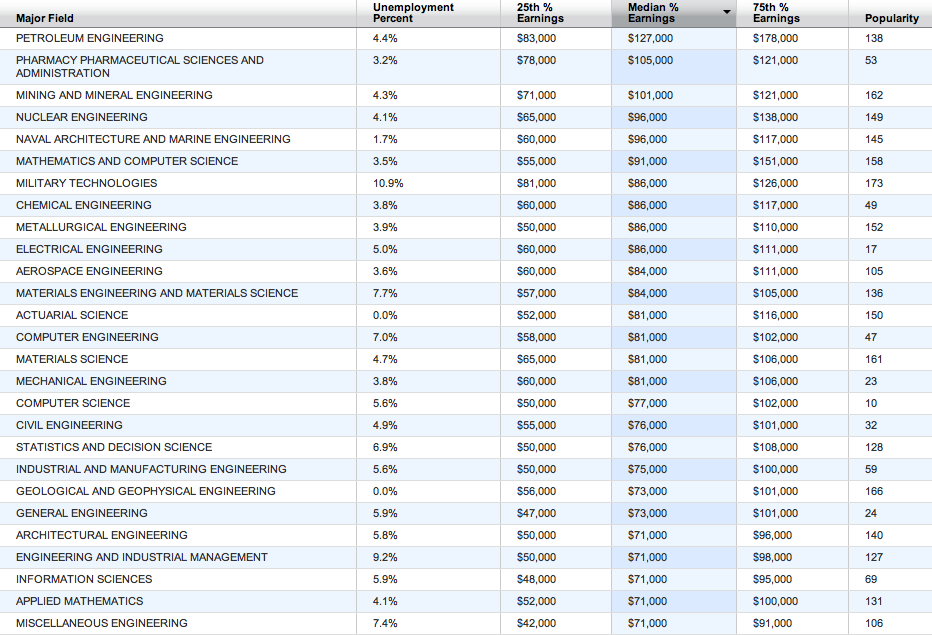
Meanwhile, the Wall Street Journal provides us with a handy interactive graphic examining unemployment rates by major according to the 2010 Census. Coming in toward the top of the list and ahead of "art history and criticism" are the sorts of degrees you'd expect, like those falling into "miscellaneous fine arts", but also "computer administration management and security", "engineering and industrial management", "international business", "electrical and mechanic repairs and technologies", "materials engineering and materials science", "genetics", "neuroscience", "biochemical sciences", and "computer engineering". I bet those graduates are all trying to break into puppetry!
I agree that the WSJ's graphic is handy, but I see different things in it than Avent does. Here are the top professions by median wages (click for larger):

Friday, October 28, 2011
UNC Everywhere
.
Friday, October 28, 2011
0
comments
Layna Mosley, one of our IR profs, has a very good op-ed in the NY Times that summarizes some of her recent research on the effect of international trade on labor rights.* Many would be surprised by the results of this work. Gist:
There is, however, a more general way in which trade agreements — and the economic ties they generate — benefit workers in developing nations. As Colombia and Panama expand their trade relationships with the United States, workers stand to gain more than just the job creation and higher wages that often come with expanded trade. Research I conducted over the last several years with the political scientists Brian Greenhill and Aseem Prakash suggests that trade with developed nations helps developing countries expand labor rights themselves.Read the whole thing.
Why? International trade gives producers incentives to meet the standards of their export markets. When developing nations export more to countries with better labor standards, their labor rights laws and practices tend to improve. Our findings, which are based on newly collected measures of labor rights around the world, demonstrate a “California effect” on workers’ rights, in which exporting nations are influenced by the labor rights conditions that prevail in their main trading partners.
*I guess Layna didn't want to get shown-up by her husband, UNC Prof Andy Reynolds, who recently had an op-ed on Libya in the News and Observer.
Tuesday, March 1, 2011
Missing the Point
.
Tuesday, March 1, 2011
2
comments
Normally Steven Landsburg is a paragon of (a certain type of narrow) rationality. I enjoy reading him for that reason, even if I often disagree with him. So it confused me to read this:
If you cut the pay of an overpaid worker, he’ll generally scream bloody murder. After all, overpaid workers like to stay overpaid. But if you cut the pay of a non-overpaid worker, you haven’t really damaged him. He just quietly leaves and gets a job elsewhere. After all, the ability to find a comparable job elsewhere is pretty much the definition of not being overpaid.
Now how are the Wisconsin public workers reacting to projected pay and/or benefit cuts? As if the rug’s been pulled out from under them, that’s how. Every time a worker says “These cuts will cause me severe pain”, that worker is saying, in effect, “I can’t get anyone else to pay me at the level I’m accustomed to”, or, in briefer words, “I am overpaid!”.
In normal economic circumstances (perfectly competitive and efficient labor markets) that might be the case. Other explanations -- some brought up by comments to his post -- emphasize that these are not normal circumstances. For one thing, the unemployment rate is near 10% despite a collapsing labor/population ratio, indicating that labor markets are neither perfectly competitive nor efficient at the moment. For another, to the extent that public education resembles a public good, it might be under-provided by the private sector relative to some social ideal, in which case public sector educators should be paid more than they would be in the private sector. So even if you accept Landsburg's premises there is plenty of econologic explaining why public sector workers are not overpaid, or at least why protests of wage and benefit cuts wouldn't necessarily be an indication that they are.
But Landsburg's premises are all wrong. The unions have agreed to wage and benefit cuts, and substantial ones. That's not what the protests are about. The protests are about legally restricting workers' rights to collectively bargain, in perpetuity. That has nothing to do with whether the workers are overpaid or underpaid. It's about a pretty basic principle concerning whether workers will be price-takers in a monopolistic system where the price is set by the state of Wisconsin, or whether they retain some bargaining power in future negotiations. . In my previous post I questioned whether the principle was really worth this sort of brinksmanship. I guess we'll find out soon enough. But to suggest that there is nothing more to the Wisconsin protests than rents being taken away is disingenuous.
Tuesday, December 8, 2009
The Diffusion of Labor Rights
.
Tuesday, December 8, 2009
0
comments
The newest issue of the American Political Science Review includes an article by UNC's own Layna Mosley (with Brian Greenhill and Aseem Prakash), "Trade-based Diffusion of Labor Rights: A Panel Study, 1986-2002." An ungated version is here. The article argues that there is a "California Effect" for labor rights that is somewhat similar to the effect on environmental policy. The abstract:
This article investigates the nature of the linkages between trade and labor rights in developing countries. Specifically, we hypothesize that a serves to transmit superior labor standards from importing to exporting countries, in a manner similar to the transmission of environmental standards. We maintain that, all else being equal, the labor standards of a given country are influenced not by its overall level of trade openness, but by the labor standards of its trading partners. We evaluate our hypothesis using a panel of 90 developing countries over the period 1986-2002, and we separately examine the extent to which the labor laws and the actual labor practices of the countries are influenced by those of their export destinations. We find that strong legal protections of collective labor rights in a country's export destinations are associated with more stringent labor laws in the exporting country. This California effect finding is, however, weaker in the context of labor rights practices, highlighting the importance of distinguishing between formal legislation and actual implementation of labor rights.
One question is whether the divergence between law and practice narrows over time. The study gives some evidence for that: all the signs are positive, and the third-year lag for the effect of bilateral trade context on practices is statistically significant even though the effect is insignificant at lags 1 and 2. Clearly, more work is necessary, and longer time horizons may be needed to truly observe any "reverse decay" effects of law on practice. If such are effects are found, it may provide evidence that including labor standards in trade agreements can have a positive effect.
Either way, this study strikes another tentative blow against "race to the bottom" arguments.
Tuesday, August 11, 2009
The Importance of Accurately Modeling Politics
.
Tuesday, August 11, 2009
0
comments
The World Bank's Private Sector Development blog notes that relaxing labor regulations (i.e. making it easier for employees to hire and fire workers) in Latin America would lead to more employment:
[O]n a net basis, making labor regulations more flexible in most countries will result in a net gain in employment. More workers will be fired, but even more workers will be hired as a result of increased flexibility. Only one country in the study (Nicaragua) would see no net gain, and a number of countries would see large net gains (e.g. Colombia and Paraguay).
So why not do it?
The tricky part is that workers who already have jobs will be naturally opposed to more flexible labor regulations. But there is a better solution than rigid regulations that keep marginal workers out of formal labor markets. As Dave argues, unemployment insurance could go a long way to softening the blow for those who lose their jobs.
At first glance, this seems like a plausible enough compromise, and perfectly in line with what John Ruggie called "embedded liberalism": a system of public institutions that smooth the convulsions of market economies while still retaining the dynamism and incentive structures that make market economies more productive than command economies. Variations of this approach still dominate the mixed systems of the industrialized world even after the collapse of the Bretton Woods system that first inspired Ruggie to coin the phrase.
But it's not clear that there is a direct link between the strength of a social safety net and attitudes towards labor market regulations. In many Western European countries, labor regulations are stronger than those in the U.S. and the safety net is more generous. This leads to dual rigidities in both systems. In much of Europe, workers with good jobs (esp. public sector jobs) tend to never lose them, and potential workers on the dole tend to stay there because their opportunities for employment are rarer and the generous welfare benefits incentivize stasis. In the U.S., easy hiring and firing in most industries leads to a more dynamic system, but less-generous unemployment benefits make transitions more painful and incentivizes workers to take the first job they can get even if it doesn't maximize their skills. So the European model leads to more structural unemployment, while the U.S. model leads to more cyclical unemployment. Both systems sacrifice some productivity in the bargain.
Many Latin American countries have chosen neither approach, instead protecting labor in the hopes that a social safety net won't be needed at all. This is fine if you are fortunate enough to get a good job, but it hurts those who cannot. Not only are the unfortunate often unable to break into the labor cartels, but they are also not protected by a welfare state. In many ways, this is the worst of all worlds. But it isn't clear that a flexibility-for-safety-net bargain is feasible. It will be difficult to persuade workers who benefit from the current system that reform is necessary. After all, most of them will never need a safety net; their jobs are secure in the status quo. Moreover, a stronger safety net will have to be paid for through higher taxation of those currently employed. A campaign platform of "increasing job insecurity + higher taxes" is not likely to garner much support.
In other words, political compromises are not made in a vacuum. The sort of grand bargain envisioned by the World Bank folks may make plenty of sense in the abstract, but only because they assume an unrealistic starting point for negotiations. When one considers the true positions of the parties involved, such a compromise looks almost impossible.
There's a reason why systemic transformations (like a re-organization of labor markets) tend to follow things like major wars and economic collapses: in normal times the status quo is entrenched; after crises there is no status quo. This is not to say that marginal improvements are not impossible in normal times, but major reforms are very difficult to achieve.
Sunday, May 24, 2009
More on US/EU Unemployment
.
Sunday, May 24, 2009
0
comments
Apropos of this post by Alex noting that the unemployment rate in the US is now the same as the average of European OECD countries, consider this passage from John Quiggin:
Advocates of the US system make much of the deterrent to hiring associated with employment protection laws, but they ignore the other side of the coin. When the economy is contract, employment protection laws do in fact protect employment (if they did not, they would have no adverse effect on hiring either).
On this basis there is nothing surprising in what we are seeing. EU unemployment rates should be higher in expansions and lower in contractions, which is exactly what is required for lower variance.
Which is better?
Short answer: that is a normative judgment. If my primary concern is improving the lot of the most people most of the time, I might think of it this way: if the "normal" state of a capitalist economy is for there to be more years of growth than recession, and I want to maximize the well-being of the most people for most of the time, then I'd go for the system with the higher variance, since a majority of the time people on the margins will be better off. Additionally, more flexible labor markets allow more labor mobility, which increases competition and boosts productivity. This, in turn, leads to additional economic growth as well as improvements that don't show up in GDP, like the improvements in home computers of similar price over time. Technological advances often generate positive social externalities that don't show up in raw GDP figures.
However, if my primary concern is to avoid sudden catastrophic outcomes for even a small minority of people, and I'm willing to trade off subtle gains for the majority to achieve that, then I might prefer the more stable, but less dynamic, European system.
Now, if unemployment increases in the Eurozone as both Alex and I expect it to do, then this might be a moot point. After all, you can't juxtapose dynamism with stability if one system or other has more of both. And it is worth noting that there is more inter-country variance in unemployment rates in Europe than across states in the US. But if there is a choice to be made, then the appropriate decision can only be made on normative grounds.
Bryan Caplan, who has his own normative views, offers up a bet:
The average European unemployment rate for 2009-2018 (i.e., the next decade) will be at least 1% higher than U.S. unemployment rate. The bet will be resolved when Eurostat releases its final numbers for 2018.
I'm happy to bet each of the three authors $100 at even odds. Will they accept?
So far, I don't believe there are any takers.
Saturday, January 17, 2009
More Sweatshop Blogging
.
Saturday, January 17, 2009
0
comments
Matthew Yglesias, of the progressive Center for American Progress, responds to the Kristof op-ed that Dr. Oatley linked to the other day:
Nicholas Kristof writes a depressing column about Cambodian kids who spend their days picking through giant heaps of garbage seeking usable scraps and dreaming of the day when they might be able to work in a sweatshop. I think it’s wrong to say that all consideration of international labor standards is merely aimed at keeping people stuck on the trash heap, but it’s a valuable reminder about the generally limited ability of just saying “no” to things to accomplish what people want. Part of the reason sweatshops exist and attract laborers is that life on the garbage heap is even worse, as is the life of a third world subsistence farmer. If you want to improve things, you need to actually be expanding the set of feasible options, not just arbitrarily closing down one path. And this happens in a variety of fields. Some neighborhoods in DC seem to have the idea that if they put tight restrictions on opening new chain stores or bars and restaurants that this will magically conjure up a diverse mom-and-pop economy. In practice, you get empty storefronts; crowded, mediocre bars and restaurants; and people driving to chain stores in the suburbs.
In both cases, there’s nothing wrong with the objective. But it’s a mistake to think that purely by vetoing stuff you can force the kind of positive action you want. To raise actual labor conditions in the third world, we need to create more prosperity and more economic opportunity not just say “no” to particular forms of bad conditions.
via Will Wilkinson, who adds:
Damn straight. Matt nails it. So why is this line of thought so elusive for so many would-be decent people? I am constantly dumbstruck that so many who profess to care about “social justice” do little more than complain that desperate people have really terrible options and then work to take away the best options.That, of course, is not the intention, but that’s usually how it ends up working, whether the issue is “sweatshops” or “human trafficking.” Some day, more of us will see the devastating irony in the fact that social justice activists spend a lot of their time making things worse for some of the world’s poorest and vulnerable people.
People who oppose sweatshops, or boycott Walmart for selling goods made in those factories, are well-meaning people who are rightfully disgusted by the working conditions in impoverished countries. But policies have consequences, and quite often the unintended consequences may do more damage than good.
Indeed, the story of industrialized capitalism over the past two centuries is that initially conditions for factory workers are harsh (though not as harsh as their next-best options). But over time, the new employment generates higher incomes than would otherwise be possible. As incomes rise, workers are able to "purchase" better options for themselves and their children. School attendance rates rise with incomes, and education and better health lead to higher productivity. More productive workers can demand higher wages and better working conditions, and the situation improves over time. This has been the story for all industrializing countries. It is sometimes tough to watch the transition, and the process never moves as quickly as we would like it to, but the worst thing we can do is stop the progress of economic activity through boycotts or demanding labor and environmental standards that are too high for the local economies to bear.
Monday, May 7, 2007
The First 100 Days
.
Monday, May 7, 2007
0
comments
Looks likely to be an "interesting" summer in France. Hope no one has plans to visit any of the government-run tourist attractions...According to the International Herald Tribune:
"Before the summer is over, [freshly-elected Nicolas] Sarkozy wants to loosen the 35-hour workweek, cut taxes and curb the power of France's labor unions. "I will not act fast, I will act very fast," he vowed last week."
But in France, the street can matter almost as much as the Parliament, and unions have already pledged to defend their privileges.Sarkozy's team has pledged not to be cowed by protests.
"We need a strong hand with the CGT in order to send a clear signal to our electorate," Fillon, the former social affairs minister and architect of a pension reform in 2003, told the weekly magazine l'Express on Monday, referring to one of France's two biggest labor unions. The CGT was one of the main organizers of two months of street demonstrations against a youth employment law that was eventually abandoned by Chirac."
Bon chance, Nicolas
Subscribe to:
Posts (Atom)

