Friday, November 11, 2011

Moral Hazard FOTD

. Friday, November 11, 2011
0 comments

Banks that took bailout money acted more riskily.

Ran Duchin and Denis Sosyura of the University of Michigan looked at the U.S.’ Capital Purchase Program. ... 
Duchin and Sosyua looked at a sample of 529 public firms that were eligible for CPP and slotted them into categories based on whether they applied, whether they were approved and whether they ultimately took the money. They controlled for non-random selection (via measures of the banks’ financial condition, performance, size and crisis exposure); for changes in national and regional economic conditions; and finally for potential distinctions in credit demand. 
They then viewed the banks’ CPP participation status in comparison with their subsequent risk appetite as demonstrated by (1) their consumer mortgage credit approvals or denials (viewed on a risk-profile controlled, application-by-application basis); (2) their participation in syndicated corporate loans for riskier credits and; (3) the risk profile of their investment asset portfolios. What did they find? ... 
Moving from this granular level to a bank-wide basis, the authors found that the CPP banks increased asset risk (using ROA & earnings volatility as proxies) while decreasing their leverage (perhaps because they knew that regulators would be keeping an eye on this metric in addition to the capitalization ratio.)
Here's the paper. This part of the abstract is very important:
Our difference-in-difference analysis indicates that after the bailout, bailed banks approve riskier loans and shift investment portfolios toward riskier securities. However, this shift in risk occurs mostly within the same asset class and, therefore, has little effect on the closely-monitored capitalization levels. Consequently, bailed banks appear safer according to the capitalization requirements, but show a significant increase in market-based measures of risk. Overall, our evidence suggests that banks’ response to capital requirements may erode their efficacy in risk regulation.
So of course global -- and many domestic -- regulations focus on capital and leverage ratios.

Thursday, November 10, 2011

Lira Lessons from Argentina

. Thursday, November 10, 2011
0 comments


The Economist's 'J.O.' on what it would mean to leave the euro:

Creating a new currency is not that difficult. A determined country could simply pass a law saying that all financial dealings should henceforth be conducted in the new lira (or drachma, or escudo, or whatever). Colleagues who have covered Argentina tell of how, in August 2001, the province of Buenos Aires issued $90m of IOUs to employees as part of their pay packets. These bills, known as patacones, were soon widely accepted in exchange for goods and services. McDonalds even offered a special “Patacombo” menu in exchange for a $5 denomination IOU. Argentina broke its "irrevocable" currency peg to the US dollar a few months later.
That's not how I read the history. How I read the history is that McDonalds was one of the only companies that would take patacones, and even then only if you had exact change. Other companies hoarded pesos (or USD) and moved them out of the country if they were able. Withdrawals of pesos from banks was strictly limited under corralito so patacones had some use, but there was a general shortage of goods and services in the economy so no currencies (besides the USD) could truly be said to be "widely accepted". As I read the history, the workers who suddenly found themselves paid in patacones surrounded government buildings in Buenos Aires in protest and demanded they be paid in pesos. The use of patacones, while perhaps the only option for a provincial government that couldn't pay its debts any other way, was a disaster and the currency was only in substantial use for a short time.

It's possible I've got my history wrong, and J.O. certainly is not arguing that issuing a new currency is painless. But I don't think it's quite as simple as (s)he says.

Wednesday, November 9, 2011

We Are Not in the 1930s

. Wednesday, November 9, 2011
0 comments

It's easy to draw parallels between these days and the 1930s, especially for an IPE scholar. Drezner does it here, I've done it before, and so has practically anybody with any sense of the international or temporal dimensions of political economy. Here's DeLong:

I have been complaining for some time now that Reinhart and Rogoff think that the time is always 1931 and that we are always Austria--that the great fiscal crisis is about to erupt and send us lurching down toward Great Depression II. Well, right now guess what? The time is 1931, and we are Austria. The Federal Reserve needs to buy up every single European bond owned by every single American financial institution for cash before the increase in eurorisk leads American finance to tighten credit again and send us down into the double dip. The Federal Reserve Needs to do so now.

Is this 1931? Here's a partial list of similarities: an system of prosperous globalization is threatening to unravel as Europe's fixed exchange rate regime crumbles; macroeconomic imbalances presage a significant financial crisis; European governments respond to large fiscal burdens by attempting to devalue internally through austerity rather than devaluing externally through the exchange rate; movements towards trade protectionism and beggar-thy-neighbor policies (outside of Europe); etc.

But I don't think we're in the 1930s. I think the world is different now than it was then in a number of important ways, and that leaves me more optimistic than I otherwise might be.

First, I think the international economic system has been transformed from the way it was during the interwar period in a number of key areas. Unlike then, international politics is now highly institutionalized. We have a series of durable trade relationships that have been legally formalized, but which provide flexibility for national governments to address pressing short-run concerns. We have a credible international organization that monitors trade and provides a mechanism for dispute adjudication. Europe has a common trade market that is likely to remain even if the monetary union dissolves. A collapse in world trade -- and thus global output -- equivalent to that in the 1930s thus seems highly unlikely.

Perhaps more importantly, the present international monetary system is not dedicated to the orthodoxy of currency values fixed to a specific quantity of a sparkly metal. This has allowed central banks, especially the central bank of the global reserve currency, to inject liquidity into the global financial system at key points over the past few years. Even the ECB, which has rightly come under criticism for not doing enough to manage the crisis despite having no legal authority to take the necessary measures, has pursued a far more expansionary policy than it would if it were trying to maintain a gold standard. Indeed it has almost certainly already acted beyond the parameters set out for it under the Lisbon Treaty. In at least some key respects, the US Fed has followed Kindleberger's advice and acted as the World's Central Bank, a role left unfulfilled in the 1930s. While the monetary authorities may not have been expansionary enough, they have done much more than anyone did during the 1930s.

Countries within the eurozone, while not bound by "Golden Fetters", are certainly bound by Euro Shackles. This load is may be too great to bear for some, but there is little doubt that at the regional level this yoke is easier and the burden lighter than the gold standard restraint of the 1930s.

There are other reasons to expect better results than the 1930s. Unlike then, Europe is not the central pivot point in the global economy. Major exporters such as China are not financially exposed to Europe, and have stockpiled foreign exchange reserves sufficiently large to keep their economy moving forward, even if the pace slows somewhat. Even the US is not exposed to European financial markets in sufficiently large way likely to be exceptionally destabilizing, especially when compared to Europe's exposure to the US in 2008 or the US's exposure to Europe in the 1930s. While contagion is a real concern, it's not much of a concern in a European crisis as it was during the US crisis. If you don't live in Europe, that is.

Finally, unlike the 1930s, nearly all of the world's major economies are consolidated democracies. While this can place some unfortunate, even tragic, constraints on short-term policymaking, in the medium run geopolitical and economic stability is likely to benefit from democratic solidarity. Factor in close security ties and the sort of security dilemmas (including economic security dilemmas) that were operating in the 1930s just don't seem to apply today.

None of which is meant to imply that the current troubles are not serious. I remain concerned that the coordinating institutions that now exist do not have sufficient authority to operate effectively. The biggest problem in Europe over the past two years has not been macroeconomic fundamentals, or a currency zone that is not optimal, or even a central bank -- solely concerned with price stability -- that fiddles while Rome burns. The biggest problem is the deficit in governance by which the Euro-level coordinating institutions cannot act without unanimous approval of member states, many of which have preferences that are diametrically opposed. At the global level the problem is both better and worse. Better because the shackles are much looser than in Europe; worse because the coordinating mechanisms are weaker than in Europe. The only game in Governance Town seems to be the G-20, which has been... underwhelming in their policy responses since 2008. The IMF seems to be caught in limbo over the euro-crisis. But in the 1930s there wasn't even a G-20. There wasn't an IMF. There wasn't a central bank at the center of the monetary system willing to take the globally-minded actions that the Fed has taken. There wasn't a US Treasury Security like Geithner who, for all his faults, can never be accused of underestimating the downside risk of financial contagion.

It's difficult to draw perfect parallels to the current situation in Europe. But if I had to pick one, it would be closer to Latin America in the 1980-1990s than Europe in the 1930s. I expect the harshest effects to remain at the regional level. The US, Japan, China, Brazil, India, and other major economies will be affected, but not severely.

The next few years, like the last few years, will be a test of the resiliency of the global economic and political architecture. So far we've done fairly well all things considered. Hopefully that will continue.  

Handicapping the Eurozone

.
1 comments

Intrade has a break-up prior to Dec 31, 2011 at 7.4%. A break-up prior to Dec 31, 2012? 52.5%

Global Imbalances FOTD

.
0 comments

By “Northern European,” I mean the 6 countries on the list above that lie between Switzerland and Norway. They have a $455 billion [current account] surplus, as compared to China’s $303 billion.
More here.

Tuesday, November 8, 2011

New Research

. Tuesday, November 8, 2011
0 comments

Are these results surprising? Not to me. And given the high barriers to entry for bargaining, we should expect to see regulations benefit large firms with a history of lobbying activity.

The Dynamics of Firm Lobbying
William R. Kerr, William F. Lincoln, Prachi Mishra 
NBER Working Paper No. 17577 
We study the determinants of the dynamics of firm lobbying behavior using a panel data set covering 1998-2006. Our data exhibit three striking facts: (i) few firms lobby, (ii) lobbying status is strongly associated with firm size, and (iii) lobbying status is highly persistent over time. Estimating a model of a firm's decision to engage in lobbying, we find significant evidence that up-front costs associated with entering the political process help explain all three facts. We then exploit a natural experiment in the expiration in legislation surrounding the H-1B visa cap for high-skilled immigrant workers to study how these costs affect firms' responses to policy changes. We find that companies primarily adjusted on the intensive margin: the firms that began to lobby for immigration were those who were sensitive to H-1B policy changes and who were already advocating for other issues, rather than firms that became involved in lobbying anew. For a firm already lobbying, the response is determined by the importance of the issue to the firm's business rather than the scale of the firm's prior lobbying efforts. These results support the existence of significant barriers to entry in the lobbying process.
This next one seems very inventive, in a "create your own science" kind of way. Has anyone else done anything like it?
Testing the Global Financial Transparency Regime
J. C. Sharman 
International Studies Quarterly Vol. 55 No. 4 
How can we tell whether rules that apply in theory actually do so in practice? Realists argue that the gap between what formal rules proscribe and their effectiveness may be particularly wide at the international level. Furthermore, dominant states may impose costly standards on others that they themselves choose not to implement. To test these propositions, the article assesses the effectiveness of international soft law standards prohibiting anonymous participation in the global financial system by seeking to break these standards. The findings indicate that the prohibition on anonymous corporations is relatively ineffective and is flouted much more in G7 countries than in tax havens. The article contributes to and extends the work of realist scholars in international political economy, both in their skepticism of formal rules and focus on the effects of power. Evidence is drawn from the author’s solicitations and purchases of anonymous shell companies from 45 corporate service providers in 22 countries.

The IPE work on exchange rate regimes continues to improve.
Fear of Floating and de Facto Exchange Rate Pegs with Multiple Key Currencies Thomas Plümper and Eric Neumayer 
International Studies Quarterly Vol. 55 No. 4

This paper adopts and develops the “fear of floating” theory to explain the decision to implement a de facto peg, the choice of anchor currency among multiple key currencies, and the role of central bank independence for these choices. We argue that since exchange rate depreciations are passed-through into higher prices of imported goods, avoiding the import of inflation provides an important motive to de facto peg the exchange rate in import-dependent countries. This study shows that the choice of anchor currency is determined by the degree of dependence of the potentially pegging country on imports from the key currency country and on imports from the key currency area, consisting of all countries which have already pegged to this key currency. The fear of floating approach also predicts that countries with more independent central banks are more likely to de facto peg their exchange rate since independent central banks are more averse to inflation than governments and can de facto peg a country’s exchange rate independently of the government.
And, lastly, an extension of Kydd's 2003 by UNC's Mark Crescenzi and co-authors:
A Supply Side Theory of Mediation
Mark J.C. Crescenzi, Kelly M. Kadera, Sara McLaughlin Mitchell, and Clayton L. Thyne 
International Studies Quarterly Vol. 55 No. 4 
We develop and test a theory of the supply side of third-party conflict management. Building on Kydd’s (2003) model of mediation, which shows that bias enhances mediator credibility, we offer three complementary mechanisms that may enable mediator credibility. First, democratic mediators face costs for deception in the conflict management process. Second, a vibrant global democratic community supports the norms of unbiased and nonviolent conflict management, again increasing the costs of deception for potential mediators. Third, as disputants’ ties to international organizations increase, the mediator’s costs for dishonesty in the conflict management process rise because these institutions provide more frequent and accurate information about the disputants’ capabilities and resolve. These factors, along with sources of bias, increase the availability of credible mediators and their efforts to manage interstate conflicts. Empirical analyses of data on contentious issues from 1816 to 2001 lend mixed support for our arguments. Third-party conflict management occurs more frequently and is more successful if a potential mediator is a democracy, as the average global democracy level increases, and as the disputants’ number of shared International Organization (IO) memberships rises. We also find that powerful states serve as mediators more often and are typically successful. Other factors such as trade ties, alliances, issue salience, and distance influence decisions to mediate and mediation success. Taken together, our study provides evidence in support of Kydd’s bias argument while offering several mechanisms for unbiased mediators to become credible and successful mediators.

Monday, November 7, 2011

Making a Mystery Where None Exists

. Monday, November 7, 2011
2 comments

Ryan Avent, at Free Exchange:

It is remarkable to me how readily old, successful professionals dismiss the labour-market difficulties of young adults as the product of their poorly-chosen majors and general lack of ambition, and on what flimsy evidence they're prepared to base these views. There are now 3.3m unemployed workers between the ages of 25 and 34. That's more than twice the level in 2007. There are over 2m unemployed college graduates of all ages; nearly three times the level of 2007. There are many millions more that are underemployed—unwillingly working less than full-time or unwillingly working in a job outside their field which pays less than jobs in their field. As far as I know, the distribution of college majors didn't swing dramatically from quantitative fields to art history over the past half decade.

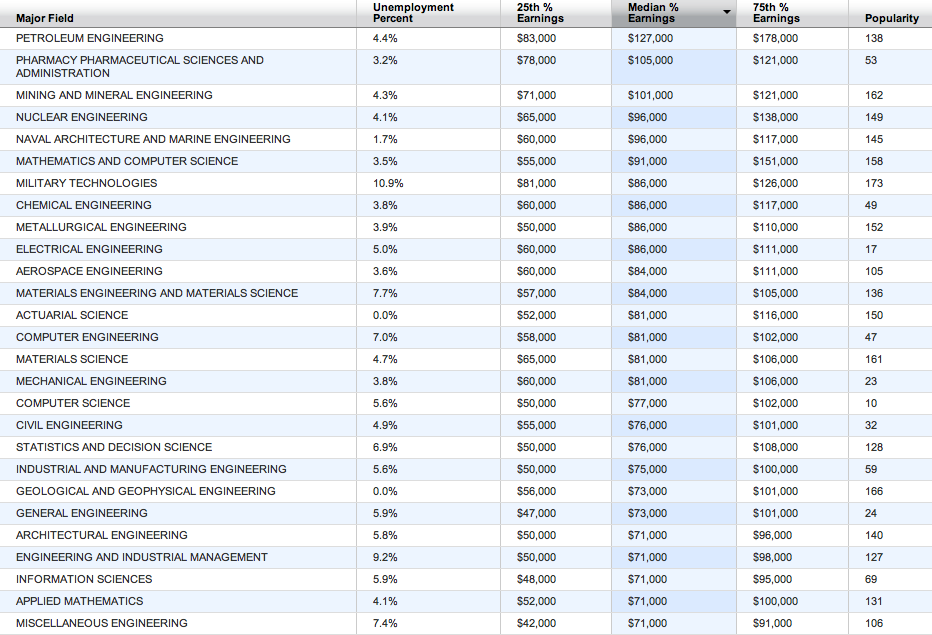
Meanwhile, the Wall Street Journal provides us with a handy interactive graphic examining unemployment rates by major according to the 2010 Census. Coming in toward the top of the list and ahead of "art history and criticism" are the sorts of degrees you'd expect, like those falling into "miscellaneous fine arts", but also "computer administration management and security", "engineering and industrial management", "international business", "electrical and mechanic repairs and technologies", "materials engineering and materials science", "genetics", "neuroscience", "biochemical sciences", and "computer engineering". I bet those graduates are all trying to break into puppetry!
Avent is correct that this recession has driven up unemployment among college graduates, but their rates of unemployment remain roughly half the national average, better than half the average of those with just high school degrees, and better than one-third of the average of those without a high school degree. (Those with postgraduate degrees are in even better shape.) Those with freshly-minted bachelor's degrees but little experience and few professional connections aren't doing as well those with many years in the professional world, as one would expect, but it still seems clear that having an advanced degree greatly enhances your ability to remain employed.

I agree that the WSJ's graphic is handy, but I see different things in it than Avent does. Here are the top professions by median wages (click for larger):


And here are those by lowest unemployment rate (click for larger):


There's a lot of quant degrees on both lists. The rest are mainly high-skill services. No humanities, no puppitry, no arts of any kind. (I'd guess that the low rates of unemployment -- albeit with fairly low wages -- in teaching and student counseling are related to the strength of those unions in the public sector, but I can't do any better than guess. And I'd wager that some of the surprisingly high rates of unemployment in some technical fields are related to educations that are out of date, but again that's just a guess.) Compare these charts to the data in this recent post by Alex Tabarrok and it seems pretty hard to deny that many students are not achieving degrees that give them an advantage in labor markets.


Friday, November 4, 2011

"You Can't Just Change the Rules Cuz You Don't Like the Outcome"

. Friday, November 4, 2011
1 comments


Terrific Office last night. After Andy gets scolded by Robert California for his mistake-prone staff, Dwight creates a doomsday machine (he calls it "an accountability booster"): if the staff make five mistakes in a day, an email that incriminates them all and recommends that the branch be closed gets sent automatically to Robert California. They all get fired and the Scranton branch closes. Of course, they spend more time trying to figure out whether it's just a scare tactic and on how to turn it off than they do working hard to avoid mistakes. Consequently, they trigger the five-mistake threshold.

Today I learn that legislators are considering how to prevent the automatic cuts in defense spending that are scheduled to take effect when the bipartisan Panel that is supposed to find some way to reduce the size of the budget deficit fails to reach such an agreement. Of course, the automatic cuts were never supposed to occur. Instead, the threat of the automatic cuts was supposed to be sufficient to force the Panel to make the adjustments necessary to avoid them. In other words, the automatic cuts are a doomsday machine. But, of course, Congress is getting scared that the Panel will fail, thereby triggering unwanted large cuts in defense spending. "Shut down the machine! Shut it down!" they now scream (watch the clip).  David Camp (R-Mich) recently begged Doug Elmendorf of the CBO to reassure him that nothing prevented Congress from "changing the mechanism for automatic cuts." Elmendorf reassured Camp, "Any Congress can reverse the actions of a previous Congress."

To restate Elmendorf's point: Congress can't commit itself. Most members recognize this. As Representative  K. Michael Conaway, Republican of Texas and a member of the House Armed Services Committee, noted, "If the joint select committee does not do what it needs to do, most of us will move heaven and earth to find an alternative that prevents a sequester from happening.” So, the threat of automatic cuts isn't credible. And because the threat isn't credible, the Panel isn't really under much pressure to find some way to cut the deficit by $1.2 trillion. As a result, maybe we shouldn't really expect the Panel to find a way to cut $1.2 trillion from the deficit because they bear no short run cost for failing to do so. Oh wait, the Times says they'll be embarrassed.

Spoiler alert: In the end, Dwight shuts down his doomsday machine. Turns out that even Dwight has time inconsistent preferences. His desire to be liked by the staff over-rides his desire to force the staff to improve by holding them accountable. The problem, of course, is that because Dwight shuts down the machine the staff will continue to screw up, and thus move inexorably closer to losing their jobs anyway. Maybe there's a lesson in there somewhere for Congress.

Thursday, November 3, 2011

The Rents Are Too Damn High QOTD

. Thursday, November 3, 2011
1 comments

From a long, excellent post by Ashwin Parameswaran at Macroeconomic Resilience. Please read the whole thing, as I expect it will be discussed a lot in the blogosphere over the next few days:

It is not the absence of rents but the continuous threat to the survival of the incumbent rent-earner that defines a truly vibrant capitalist economy.
This, in a nutshell, encapsulates much of the disagreement between Marx and Schumpeter: the former saw this threat as decreasing over time, while the latter saw it increasing. Perhaps one way to read the post-WWII economy is that Schumpeter is right over longer time horizons, but that the process is prone to fits and starts. In the shorter run Marx may well have the better hand.

Parameswaran goes on to link this to the Great Stagnation, theories of unemployment, Minsky, Keynesian/post-Keynesian macro, and much else besides. I'll be pondering this post for a long time.

Wednesday, November 2, 2011

There Is No Technocracy QOTD

. Wednesday, November 2, 2011
1 comments

Felix Salmon nails it in a post titled "All bank regulators are captured":

The fact of the matter, however, is that all regulators are captured by banks. Or, to be a little more precise, all legislatures are captured by banks, and all regulators do what the government tells them to do. 
In countries like Canada and India, there’s a very small number of strong, well-capitalized banks with a vested interest in maximizing barriers to entry. So they’re happy with very tough standards. In Europe, national banking systems are also concentrated, so in theory they could go the same way. But European banks are more likely to have cross-border and global ambitions, and in any case as a matter of contingent fact they’re not very well capitalized. So they get the regulation they want — which allows them to grow fast without having to raise lots of expensive new equity capital.

And then there’s the US, which is pretty much unique among major economies in having thousands of pretty vibrant small banks. Those small banks have a lot of political clout in Congress, and they hated Basel II, because they’re not nearly sophisticated enough to take advantage of it. So they essentially bullied Congress into keeping the old Basel I standards, for fear that otherwise they would be at a massive competitive disadvantage with respect to the big US banks like JP Morgan Chase. Congress obliged, and used the FDIC as its chosen mechanism for blocking the adoption of Basel II in the US.  

Does that make the FDIC particularly virtuous? No: it makes the FDIC just as beholden to the banks as any European regulator. Look at the banks’ contributions to the FDIC insurance fund, for instance: they fell to zero, for no good reason, just because the banks didn’t like making those payments.
Cross-national differences in regulations are not due to one country's regulators being somehow wiser than the rest. It has to do with different organizations of domestic interests within (and across) countries. These lead to different policy outcomes.

Paul Krugman does not in a post titled "Crats, Maybe, But Not Much Techno":
But it’s more than that: these alleged technocrats have in fact systematically ignored both textbook macroeconomics and the lessons of history in favor of fantasies. The European Central Bank has placed its faith in the confidence fairy, while imagining that it can run policy in a way that has never worked in several centuries of central bank experience. Meanwhile, the European policy elite has simply wished away the clear evidence that the euro zone needs to make an adjustment that is virtually impossible unless inflation targets are raised.

The point is that I know technocrats, and these people aren’t — they’re faith healers who are making stuff up to suit their prejudices.
I contend that Paul Krugman does not know technocrats. He knows people who have different priorities than those he dislikes in the government and punditocracy. He claims that his side are the true technocrats -- untainted by avarice or bias -- because that gives them a moral authority that they would not otherwise have. But Krugman's preferred "technocrats" are just those who prioritize labor over capital, to use a short-hand, while those he decries have the opposite preference. As Salmon notes, capital generally wins, but in varying ways that reflect their varying preferences in disparate places.

"Textbook macroeconomics" presupposes a political system that is dedicated to the pursuit of utilitarian aims, a "socially optimal" mix of outcomes. But there is no universally agreed upon social optimum. There are only different, competing interest groups with different, competing preferences. Rousseau was wrong about this. There is no General Will, only the Sum of Private Wills. Some interests are narrower than others, as OWS has figured out, but that's really the only difference.


International Political Economy at the University of North Carolina
 

PageRank

SiteMeter

Technorati

Add to Technorati Favorites