Showing posts with label Banking. Show all posts

Sunday, June 30, 2013

Distributional Politics of the Ice Cream Parable

. Sunday, June 30, 2013
8 comments

Tyler Cowen is thinking out loud:

This parable assumes that [monetary] injection effects are important, namely where the new money goes first. This Austrian-like view is unfashionable, has weak theoretical foundations, and violates the Modigliani-Miller theorem, but at the moment markets seem to believe it. Should we believe it too?
Yes we should. Or at least we shouldn't let Modigliani-Miller stop us. In his 2011 Presidential Address to the American Finance Association, John Cochrane said the following:
Discount rates vary a lot more than we thought. Most of the puzzles and anomalies that we face amount to discount-rate variation we do not understand. Our theoretical controversies are about how discount rates are formed. We need to recognize and incorporate discount-rate variation in applied procedures.
If discount rates are varying a lot -- across time, space, and actors -- then a representative agent model such as Modigliani-Miller is not going to perform very well. And, as it turns out, it doesn't. I have paper, while I'll be sending out for review soon, which drills down at banks' activities (at the firm level) across countries and time. It turns out that there is all kinds of variation being driven by a whole host of variables at multiple levels of analysis. Which, you know, we all know intuitively... but it's not what our models expect. So let's ditch Modigliani-Miller. Capital structure is clearly not irrelevant in the real world.

Going back to Cowen, here's something with which we might be concerned. Central banks act by trading debt instruments for others at price. In normal times the swap is either short-term sovereign debt for cash or present dollars for future dollars plus interest. In our current environment, it's practically anything for cash. Who benefits from this situation? Those who can create debt that can be sold to the central bank for cash. In normal times this has primarily been governments, but governments are doing everything they can to stop creating debt. So who does that leave? Banks.

Because central banks want to be active they have been broadening the range of debt instruments that they will conduct business in. So here's a worrisome dynamic: governments are trying to reduce debt, while banks are being encouraged by central banks to create debt instruments which they can trade for cash. Karl Whelan may be correct that traditional solvency concerns don't apply to central banks, but that doesn't mean that there aren't knock-on effects from this.

The upshot is that expansionist central bank policy requires somebody to lever up. If governments won't do it and households can't do it then banks and large corporations pretty much have to. The more activist the central bank wants to be and the less indebted the government wants to be, the more banks have to create debt instruments however they can. Possibly that could mean loans to individuals and smaller firms, which could be stimulative, but households and firms are deleveraging. Meanwhile, bank regulators are telling banks to stop lending to risky groups. So where's the debt going to come from?

Banks and big credit-worthy firms are going to do very well. They're getting debt finance for free, so their equity can be deployed elsewhere or held in reserve. This is why stock markets are up so much. This is why Apple and other corporations are taking out loans when they don't even need the cash and have no real plans to do much of anything with it in the short run. Everyone else is not going to do very well, because the traditional mechanisms for distributing from central banks to the citizenry -- fiscal policy plus bank loans to individuals and small firms -- is being cut out of the story. In one sense that might be okay if the future costs of debt servicing are higher than the expected return folks would get from borrowing. But the distributional implications of this are clear: the economy is going to become more unequal and less efficient. Credit is not being allocated to facilitate productive investment -- there might not be many -- but to create debt instruments to sell to central banks for cash. The policy mix we have right now practically requires inequality to go up, which is a sign that the economy is seriously imbalanced.

One alternative is to let risk back into the system but I don't hear anybody calling for that right now.

At some point central banks will be pressured to tighten. It looks very likely that this will be under conditions of steady but slowish growth. This is where the Big Unknown comes in. When that day comes will banks (and corporations) start using their cash productively or keep hoarding it? Given the experience of the past decade or so, will there be many people who even want to borrow in order to build a McMansion or buy a luxury car or MBA? If they did, will regulators let banks lend to them? Will the originate-securities-and-distribute-to-surplus-countries market come back as strong as before?

Tuesday, April 30, 2013

Regulation Is More Complicated Than You Think

. Tuesday, April 30, 2013
0 comments

Some of my research involves the regulation of bank capitalization, including the use of risk-weights. One of the things I constantly emphasize is that there are many misconceptions in the academic and policymaking communities about the relationship between banks and regulations. Here, for example, is Per Kuwoski complaining about the international Basel capital accords:
The first fact is that since banks are allowed to hold less capital, and therefore to leverage the risk-adjusted margins more on their capital, and therefore to obtain much higher expected returns on equity when lending to what is perceived as “safe” than when lending to what is perceived as “risky”, current regulations are completely distorting our financial system. 
That has caused banks to create excessive exposures to what was erroneously perceived as risky [ed.: I think he means "safe"], like in AAA rated securities, Greece, real estate, and to refrain from lending to those in the real economy perceived as “risky”, like small businesses and entrepreneurs.

The second fact is that the first fact is not even mentioned, much less discussed.
The point is that prior to the crisis banks were doing what they were supposed to do. The epicenter of the crisis was located in some of the safest categories of financial instruments: OECD sovereign debt and highly-rated securities, both of which were privileged in the risk-weighting scheme under the Basel accords. The crisis didn't occur because of junk bond trading; it occurred in part because everyone (including the banks themselves, apparently) thought banks were acting safely when they were actually concentrating evermore risk at the center of the global financial system. This means that increasing capital requirements under the current regulatory structure is likely to increase the exposure financial institutions have to these types of assets, these types of risk, and thus the sort of crisis that we've just experienced.

Was the risk-weighting system gamed? Of course it was*, particularly by the mid-2000s when the world's demand for "safe" financial assets denominated in dollars massively out-stripped supply. Safe financial assets were defined by the regulatory code, so there was quite a lot of money to be made by creating assets which would be considered safe by regulators and selling them. Was there outright fraud? Some, yes, although it's hard to find solid evidence that this was as pervasive a feature of the financial system prior to the crisis as many assume; it's even harder to demonstrate that fraud led to (or even contributed to) the crisis. It's much easier to see how gaming of the system could have.

But what banks were not doing is "racing to the bottom". That is, they were not bumping up against their minimum regulatory requirements by taking on as much risk as they were legally allowed to do*. Instead, they were piling into "less risky" assets because those were rewarded by the regulatory code. And the more that these types of assets are rewarded (or required) by the regulatory code, the more banks will game the system in increasingly opaque ways. It's what they're being asked to do, after all.

What is to be done? Some, like Kurowski and also Vice-Chairman of the FDIC Thomas Hoenig, want to abandon the risk-weighting system altogether. Their views are represented by new bipartisan legislation which was introduced into Congress by Brown and Vitter last week, which has the support of everyone from community bankers to Simon Johnson. The gist: force banks to fund some percentage of their investments with equity rather than debt, but let them (and their investors and counterparties) determine what assets are risky and what are not. Keep the system simple; the more complicated it gets, and the more beneficial it is to pursue profit through regulatory arbitrage, the more it will be gamed.

But so far the political discussion of this has often reduced to a simple lobbying story: banks don't want to be regulated, and they've got the power, so the regulation will be weak. This is both an incredibly simplistic view of regulatory politics, it is also wrong in at least some cases. Banks don't like some kinds of regulation, it is true, but bank preferences are not homogenous. All regulations have distributional consequences, so some firms will support them while others oppose them. We're seeing that with Dodd-Frank and Brown-Vitter and we've seen it in previous rounds of the Basel accords.

The point is that banks (and other financial firms) have asymmetric interests, and that these interests are conditioned by the regulatory environment. Just making the regulatory environment "tougher" won't necessarily punish large financial institutions (it'll often help them), and may concentrate risk in opaque parts of the financial system. This is arguably the worst possible result. Unfortunately, it may be the most likely under current policy.

*If by "game the system" you mean doing essentially what the regulatory code wanted them to do: invest in sovereign debt and asset-backed securities.

**If you doubt me, I can prove it. Part of the work is forthcoming in peer-reviewed form; other parts will hopefully find a home soon.

Tuesday, June 19, 2012

Potential Consequences of the EU's Proposed Regulatory Changes

. Tuesday, June 19, 2012
0 comments

The European Union is considering a dramatic revision of the current institutional arrangement concerning banking regulation and supervision. Currently, members of the EU must implement international capital standards -- the Basel accords -- but regulation of domestic financial sectors is left up to national governments. Some governments choose to have their central banks regulate, others give that authority to a separate agency; each is fine under current EU rules.


That may change. Given the instability in the EU banking markets, and the fact that EU members must allow free movement of capital within the EU, the institution is considering moving supervisory authority to the transnational level:
The leaders of France, Germany, Italy, Spain and Austria are willing to back a powerful supranational supervisor, and a decision to relinquish national control over cross-border banks is being prepared for next week’s EU summit, according to senior officials. One said the new-found political impetus was “astonishing”.
The "astonishing" political impetus has come from the fact that the EU is currently experiencing a number of bank runs, capital flight from the periphery to the core, and a general lack of trust in the solvency of many of its financial institutions. To shore up confidence, many in the EU would like to create a "banking union" that would involve continent-wide deposit insurance for EU banks. In exchange for that guarantee, states would have to give up sovereignty to a higher body, which would presumably be heavily influenced by the core European countries (in this case, Britain, Germany, and France).

What would the effect of this be? It turns out that I've done some research on that question.* That work suggests that the answer is: it depends. Specifically, it depends on who the regulator would be. The top two choices appear to be the European Central Bank and the European Banking Authority. Why does it matter?

My research, building off of some work by Copelovitch and Singer, argues that giving regulatory authority to central banks alters the policymaking incentives that central bankers face. Without getting too wonky, it incentives central banks to privilege the needs of the banking sector when choosing monetary policy, as financial instability could lead to the loss of their authority. This, in turn, incentivizes banks to behave more riskily, as they expect to receive preferential treatment from sympathetic central banks, so long as they stay above the statutory requirements. The cumulative result is a more bank-friendly monetary regime (the Copelovitch and Singer result) and a more risk-friendly banking sector (my result, supported by a ton of statistical tests). This may not be what the EU currently has in mind.

On the other hand, regulatory central banks may be better able to prevent financial instability in the first place by tailoring policy to the needs of the financial sector. I do not explicitly study this question, and I doubt it is strictly true, but central bankers have argued according to this logic in the past. Alternatively, unifying regulatory and monetary authority could reduce institutional competition and lead to better-coordinated policies. Of course, if that coordination is in a direction that rewards greater risk-taking by EU banks then that might not be the best thing.

*Currently under review so no link, but interested parties can e-mail me for a copy.

Monday, June 4, 2012

Annals of Silly(?) Policymaking: Procyclical Financial Regulations During a Bank Run Edition

. Monday, June 4, 2012
0 comments

This (via @dandrezer) does not seem smart:
Banks must raise their core tier one capital ratios to 9pc by the end of this month or face the risk of partial nationalisation. The global Basel III rules are also pressuring banks to retrench.  
The International Monetary Fund said banks will have to slash their balance sheets by $2 trillion (£1.6 trillion) by the end of next year even in a "best-case scenario".
That is only within the European Union, and it came about due to panic over Greece last month. Basically, this means that EU banks have to increase their capital cushions by over 200% by the end of this month. What does that mean?
The Bank for International Settlements (BIS) said cross-border loans fell by $799bn (£520bn) in the fourth quarter of 2011, led by a broad retreat from Italy, Spain and the eurozone periphery.
Note that this just in Europe. But it made me wonder (on Twitter): why do this now? After all, it was Germany that insisted on a longer phase-in period for Basel III during negotiations, while the US/UK/Switzerland wanted that stricter capital requirements. Now the EU is doing a rapid phase-in and tougher capital limits years before they are required to by Basel. And they're doing it in the middle of a bank run during a continent-wide recession. What gives? A few things.

1. Banks do have to get to 9% tier 1 capital by the end of the month, but they don't have to come fully into compliance yet. That is, a lot of junk capital that is prohibited by Basel III -- but was allowed under Basels I and II -- will still be allowed. (ht to @Procyclicality for this point)

2. Nevertheless, this is still a big boost to minimum capital standards. So how will banks come into compliance? Two quick and easy ways are to:

a. Hold more cash.

b. Buy more sovereign debt.

The first of these is contractionary -- it's basically hoarding more cash rather than lending it out -- although the ECB can facilitate it if they want to pump eurozone banks full of cash. Non-euro EU central banks, such as the Bank of England, can do the same thing if they want and the US Federal Reserve has injected a bunch of liquidity into foreign banks when needed in the past as well. As a zero-risk instrument, cash has a zero risk weight, so adding more of it to your portfolio brings your overall capital ratio up.

The second of these is expansionary. OECD sovereign debt also carries a zero risk weight under Basel III, as it did under Basels I and II. This might seem bizarre at first, but remember who's making these rules: OECD governments. And OECD governments want to pay low interest on their debt. To do that, they rig the regulatory rules to make it more attractive for financial institutions to buy that debt. Hence, a zero risk weight in Basel.

So what does that mean? If banks need to boost their capital stock, there are two ways to do it: by raising more capital (e.g. by selling equity) or by shifting their risk portfolio. The former latter will be often preferred to the latter former, so banks are essentially being encouraged to buy sovereign debt (and other zero risk weight instruments) in order to come into regulatory compliance.

Was this the point of this policy? I don't know. Probably it was mostly a freak-out after runs started on Greece and then Spain. But I imagine it was part of the calculus, or at least has become so since. In practice this will likely be a transfer of private funding for public funding. Given that the ECB cannot provide liquidity directly to eurozone governments, but can accept sovereign debt as collateral when lending to banks, this could be part of a stealth bailout program that began when Mario Draghi took over as ECB chief from Jean-Claude Trichet last year. Call it "bailout by regulatory arbitrage".

Will it work? I don't know.

Tuesday, December 6, 2011

(There Can Be No) Flight to Safety Uh-Oh GOTD

. Tuesday, December 6, 2011
0 comments


Yikes. Clear here for bigger image. Discussion here, including this:
Historically, a Triffin Dilemma — and that’s kinda what this is — leads to funky innovations in the shadow banking system and all the complications that such innovations bring. Will the whispers of new kinds of financial alchemy get louder?

You can see in the chart that before the crisis, US Treasuries were an important but minority amount of the world’s stock of safe haven assets. Treasuries are now the vast majority of such assets. But this is because of the extraordinary decline in the other kinds of assets and because of quantitative easing by the Fed, not because the outstanding stock of Treasuries has increased by so much.
Perhaps the outstanding stock of Treasuries should increase.

Via Counterparties.

Wednesday, October 12, 2011

What Do Regulations Do?

. Wednesday, October 12, 2011
0 comments


I believe I wrote about this year-old post by John Hempton awhile ago, but it's worth revisiting. I like the way he thinks about the effect of financial regulation:

In the UK banks were allowed to lever themselves to a silly extent (similar over-leverage occurs in their life insurance companies). Overleverage as a policy was the defining character of Northern Rock. 
Individually it makes sense for banks to lever up. However competition was intense - and collectively it was insane. Northern Rock was levered 60 times or so - but to mortgages that were really thin margin. Their spreads were about 40bps.   
What I suspect is happening is all the banks are standing on tippy-toes. It is individually rational - collectively insane because competition kills the benefit of all that extra leverage. Margins in the UK - the most over-levered market on the planet - fell further than anywhere else.  
Of course competition was good for borrowers - at least for a while. Lower spreads meant cheaper finance - but not dramatically cheaper. Spreads of 150bps on mortgages levered 15 times is about as profitable as spreads of 40bps levered 60 times. Competition might drive spreads down by 110bps - at the risk to the whole banking system.
In most of the popular discourse and academic literature banks are presumed to be opposed to regulation, because it corrects market inefficiencies by forcing firms to internalize negative externalities*. The public choice school** argues that there are times when this is not the case -- when incumbent firms can use regulatory structures to collect rents -- so there is no reason to start from the assumption that regulations will be welfare-enhancing.

Hempton is proposing something else: thinking of financial markets as creating a prisoner's dilemma for banks. In this case, banks would be better off if they were able to collude. They'd be able to maintain fairly large spreads, and thus profits, without taking on inordinate risk. The "cooperative" outcome is Pareto-optimal (for the banks at least). But it isn't individually rational. If all the other banks are maintaining higher standards, you can capture quite a lot of market share by "defecting" -- levering up, in this example. To do this you will have to accept lower margins, but profits will still increase if you increase volume enough.

Of course what is individually rational for one firm is individually rational for all firms, so just like in a prisoner's dilemma everyone "defects", driving down margins without capturing any more market share. In this scenario, bankers would prefer regulations like minimum capital adequacy and limits on leverage,  not because it bestows rents (at least not only for that reason), but because it changes the structure of the strategic interaction. Firms can now attain Pareto-improving outcomes where they can achieve a decent profit at fatter margins without taking on so much risk. So, ceteris paribus, in this situation firms should actually prefer to be regulated so long as everyone else is regulated too.

And, in fact, in the wake of the financial crisis every banker said they supported re-regulation of the financial sector so long as it affected everybody. But here's the kicker: the same dynamic that makes regulation Pareto-improving also makes regulatory avoidance very lucrative. If you can figure out a way to arbitrage the regulation, you can capture more market share at a slightly lower margin, thus boosting profits. In terms of the prisoner's dilemma, you can profit by defecting while everyone else cooperates. The rise of the shadow banking system is best understood in this light.

Meanwhile, I'm not as perplexed as Drezner is by recent developments in domestic and international regulatory regimes. First, Basel III went basically the way previous rounds went. This process isn't as simple as "bank preferences are communicated to national governments, and also includes the preferences of voters and policy elites. Second, the majority of the Dodd-Frank rules haven't been written yet, must less implemented so it's far too soon to say that bankers have "lost" in any meaningful way. Third, there are very real concerns that the EU won't be able to begin enforcing Basel III any time soon, which could potentially affect the competitiveness of US banks (this is what Jamie Dimon was talking about when he called Basel III "anti-American"). Fourth, Dodd-Frank contains dozens of provisions on top of Basel III, some of which could effect international competitiveness (although most won't).

Lastly, I think Drezner is making too much of the fact that the banks aren't getting everything they want. They are still getting quite a lot -- Dodd-Frank implementation is slow, underfunded, and every GOP candidate vows to repeal or otherwise castrate it -- but they never get everything they want. Finance is one of the most heavily-regulated industries in the country. They routinely lose political fights. The influence of bankers on politics is real, but it is quite often over-stated.

*A line of thought that began with Pigou, who wrote more about taxation than regulation, but the fundamental principle is the same.

**Notably Stigler and Peltzman, extended onto the international level by Oatley and Nabors.

Tuesday, October 11, 2011

New Research

. Tuesday, October 11, 2011
0 comments

On the Network Topology of Variance Decompositions: Measuring the Connectedness of Financial Firms Francis X. Diebold, Kamil Yilmaz
NBER Working Paper No. 17490
We propose several connectedness measures built from pieces of variance decompositions, and we argue that they provide natural and insightful measures of connectedness among financial asset returns and volatilities. We also show that variance decompositions define weighted, directed networks, so that our connectedness measures are intimately-related to key measures of connectedness used in the network literature. Building on these insights, we track both average and daily time-varying connectedness of major U.S. financial institutions' stock return volatilities in recent years, including during the financial crisis of 2007-2008.
This is important work, and I know that several regulators and central banks (including the Bank of England) are starting to take this sort of modeling -- weighted, directed networks -- very seriously. When you're trying to track sources of systemic weakness you really need to know what the system looks like. The problem isn't just "too big too fail", it's also about which firms are tightly connected to many other firms. These two will often correlate, but not always and not perfectly, so knowing the difference is important.

The Stock Market Crash of 2008 Caused the Great Recession: Theory and Evidence Roger Farmer
NBER Working Paper No. 17479
This paper argues that the stock market crash of 2008, triggered by a collapse in house prices, caused the Great Recession. The paper has three parts. First, it provides evidence of a high correlation between the value of the stock market and the unemployment rate in U.S. data since 1929. Second, it compares a new model of the economy developed in recent papers and books by Farmer, with a classical model and with a textbook Keynesian approach. Third, it provides evidence that fiscal stimulus will not permanently restore full employment. In Farmer's model, as in the Keynesian model, employment is demand determined. But aggregate demand depends on wealth, not on income.
I think some of this gets to my confusion about Keynesianism from a few days back. I think the last sentence particularly drives at what I was saying before: if the monetary multiplier is low because of expectations, then how can the fiscal multiplier be high under the same set of expectations? It makes more sense (to me) for behavior to be conditioned by wealth more than income, particularly if the income is temporary. I clearly need to become more familiar with Farmer's work.

And here's a near-complete preprint of Herb Gintis' most recent book, The Bounds of Reason: Game Theory and the Unification of the Behavioral Sciences. Via one of Phil Arena's commenters.

Thursday, September 22, 2011

"Macroeconomic Events Have Macroeconomic Causes"

. Thursday, September 22, 2011
0 comments

That's D^2, saying we need to do better than "the bankers are all bastards" as an explanation of the state we're in. In my view he doesn't talk enough about the political causes of the recession, nor the international dynamics at play, but a good post nonetheless.

Monday, September 5, 2011

System Dynamics Remain Important

. Monday, September 5, 2011
0 comments

(click here for animation)

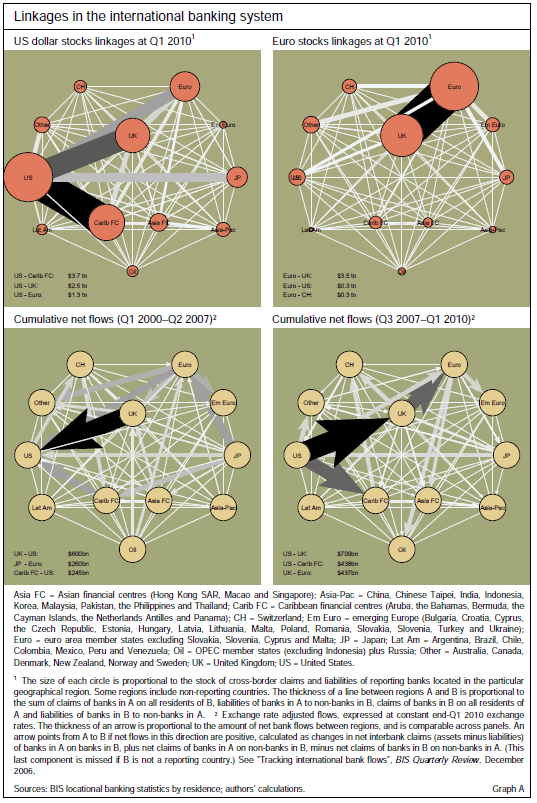
Via TC, a data point that reinforces some research that the IPE@UNC crew has been conducting:

MFIs in Europe have drained their bank accounts at European banks by about €700 billion over the past year and half, which at current exchange rates is approximately $1 trillion. It seems that much of that money has recently found its way into the bank accounts that European MFIs keep in US banks. And conversely, it seems likely that the large inflow of cash deposits held at US banks this year is largely from European banks.

Putting it all together yields a compelling story: European banks are shifting their cash assets out of European banks and putting much of them into US banks. This has happened at a significant rate, with a net transatlantic flow from European to US banks that probably totals close to half a trillion dollars in just six months.
Given all of the trouble in the US banking sector over the past four years, and given the recent S&P shot, why would foreign funds continue to flow into the US rather than, say, emerging economies that continue to grow at high rates? This sort of behavior is not expected by most political science, economics, or finance research or by many in the pundit and investing classes.

One answer may be found by examining the network dynamics embedded in the international banking system, one representation of which is above. (This graphs in-degree, which are bank holdings from country i to country j. Tie strength is the amount of holdings, node size is cumulative in-degree from all countries in the network.) The international banking network is highly unequal, with the US as the most central node in the system. Highly unequal networks have different dynamics than other networks, one of which is a "preferential attachment" rule for organizing links between nodes. The rule states that, because of network externalities, nodes that attract a lot of links will tend to attract even more links in the future. Thus, the structure of the network is stable and self-reinforcing.

The US has attracted by far the most foreign bank holdings throughout the entire data series, and the intensity of these links has increased (in nominal terms) over time. That process hesitated briefly at the height of the financial crisis before resuming. So given the structure of the network and the dynamics that that structure implies, increased flows into the US -- especially during times of trouble like those currently plaguing Europe -- is exactly what we should expect. If we didn't continue to see this behavior that's when we would need to start looking for major changes to the organization of the global economy.

Thursday, August 4, 2011

Regulatory Politics

. Thursday, August 4, 2011
0 comments


The EU is working to implement Basel III:

New European Union rules designed to make the financial system safer would require banks operating in Europe to raise an estimated €460bn in capital by 2019 or substantially reduce their risk and balance sheets.

The draft proposals unveiled on Wednesday – which still need approval from the 27 member states and the European parliament – make the EU the first jurisdiction to start implementing the global Basel III capital and liquidity guidelines that were adopted last year.


The new Basel capital definitions hurt EU banks more than US banks, as they focus on improving capital quality by mandating more equity and less debt. As a result, EU banks -- still suffering from the crisis and recession, and on edge over sovereign debt holdings -- have to raise more capital than many of their foreign competitors. Predictably, they don't like that:

Industry groups in the UK and Germany warned that if the EU moves too far ahead of the rest of the world, its banks could lose out to international competitors and cut lending to the real economy. The projected capital shortfall, equivalent to 2.9 per cent of all the EU banks’ risk weighted assets, goes a long way towards explaining why EU banks are among the fiercest critics of the Basel III proposals.


Banks and some other groups argue that this will have an adverse effect on economic growth at a time when the EU can had afford it; while there might be some truth to that some new research shows that too much finance can actually retard growth, and that this is currently the case in some EU countries.

But the competitiveness argument seems to be undercut by this:

The EU’s draft proposals are likely to unleash months of heated debate, as member states and banking institutions haggle over the details. Some countries – including the UK – are still fighting for the flexibility to introduce national requirements that are higher than the EU minimums.


If competitiveness is such a big worry then why would any states have stricter requirements than required by international agreement? Note that this is nothing new; the US had stricter capital requirements than Basel I and II in order for firms to be considered "well capitalized" by the FDIC. And World Bank surveys conducted in 1999, 2003, and 2006 showed that 40-50% of countries had capital standards stricter than the Basel minima even before the financial crisis. The above heat map shows those results in 2006*. Since the crisis many countries have proposed or enacted new regulations that are tighter than their international obligations.

Most existing literature on regulation in finance, economics, or political science does not expect this type of behavior by governments**. Episodes like this suggest that we need to complicate our expectations about the ways that domestic and international politics interact, and the process by which governments set policy in a competitive global economy. It isn't unidirectional neoliberalism, even before the crisis. This is the focus of my dissertation research, so I'm sure you'll all be hearing plenty more about it in coming months. For now let's just say that this type of behavior follows the precedent of previous periods of crisis and regulatory reform.

*Darker colors indicate higher capital requirements. White is missing data. The Basel minimum of 8% is the light orange, as in the US. Note that much of the variation on this variable is in the developing world.

**Or the equivalent behavior of firms, which "over-comply" with capital regulations as a rule, albeit at different spreads.

Monday, July 11, 2011

The World's Central Banker, Again

. Monday, July 11, 2011
0 comments

Foreign banks are arbitraging the Fed:

Up until April this year, US banks had a nice little earner.

As Freakonomics explained, big banks were able to borrow cash from the Fed funds or repo market for say, 15 basis points, posting US Treasuries as collateral, and then deposit the cash received with the Federal Reserve overnight at 25bps, earning some 10bps. The FT has estimated that since late 2008, this risk-free arbitrage may have netted America’s banks as much as $200m in profits.

The arbitrage-opp came to an end in April, however, when the US Federal Deposit Insurance Corporation’s (FDIC) introduced a new fee on banks, essentially eliminating the 25bps-grab.

Small problem. It seems the new FDIC rules don’t apply to many non-American banks. And foreign banks, we should all know by know, also have access to the repo markets and federal funds.


Moreover, this is a good thing. The Eurocrisis may have been more destabilizing than it has been if foreign banks didn't have an easy way to recapitalize. And it doesn't hurt the US. Well, it hurts US banks, which don't have the same opportunity, but that provides an incentive for them to lend to the real economy, which is needed.

Also note this:

... the reported assets of US branches of foreign banks are up 250 per cent since the end of last year, now making up a whopping 48 per cent of their total assets. Basically, foreign banks have absorbed all of the growth in reserve balances in 2011.

Wednesday, June 29, 2011

Regulatory Regret

. Wednesday, June 29, 2011
0 comments

Suppose policymakers send a clear signal: banks that are "too big to fail" will be bailed out, so in return they must bear a stricter regulatory burden. Banks that are not too big to fail will not be bailed out, so they have a laxer burden. What incentive does that give to banks... get bigger to capture the guarantee, or get smaller to avoid the stricter regulation? Depends on the regulation. But I don't see any large bank responding to Basel III or Dodd-Frank or any other regulatory change by desperately trying to reduce size. That should provide some indication of what margin we're operating at. And even if the banks are small enough to fail without systemic consequences, that doesn't necessarily mean their creditors are:

Governments across the world are committed to allowing banks to fail in the future. Socialising bank losses is unpopular, and it creates moral hazard. However, when national banking sectors remain fragile, imposing burden-sharing resolution regimes is fraught with danger. Governments and regulators may chose safety first. Witness the ECB’s continuing refusal to allow haircuts for the senior bondholders of Irish banks. They, it seems, are definitely too big to fail.


Also remember 1907. The problem then wasn't too big to fail. It was too small so they failed. Larger institutions gain greater confidence than smaller institutions. The 1907 panic stopped only after JP Morgan (the man) intervened, so says the myth. That strategy repeatedly failed in 1929, as Galbraith's The Great Crash notes, but in 2008 the crisis may have been much worse if huge institutions didn't exist to merge with other huge institutions. Small institutions can't easily take on others' balance sheets in times of trouble, at any price.

The point is that there are downsides to decentralized finance. TBTF is a real problem, but it's not the only problem. Constructing regulations to punish TBTF firms could actually reward them. I can easily imagine Wall Street executives wearing their SIFI ("systemically important financial institution"*) designations as badges of honor. And counting on them as explicit blank checks from governments. Who wouldn't want a SIFI as a counterparty? Almost as good as a GSE.

*Subject to stricter capital requirements under Basel III.

Tuesday, June 28, 2011

Capital Is Political

. Tuesday, June 28, 2011
0 comments


Joe Nocera and Bethany McLean, co-authors of financial crisis account All the Devils Are Here, have competing op-eds on the importance of raising capital ratios. Here's how Nocera's starts:

Capital matters. Let me put that another way. The current fight over additional capital requirements for the banking industry, eye-glazing though it is, also happens to be the most important reform moment since the financial crisis broke out three years ago. More important than the wrangling over Dodd-Frank. More important than the ongoing effort to regulate derivatives. More important even than the jousting over the new Consumer Financial Protection Bureau.


And here's McLean:

Think about the past (the financial meltdown in 2008) and the present (the fear that a default by Greece will ignite another financial crisis ). If banks had held more capital, would we have avoided either mess? I'm afraid the answer is no.


Here's how I'd sum up the difference. McLean argues that all bank crises stem from runs on banks, and when a run is on no amount of capital can stop it. Yes, Nocera might respond, but runs are crises of confidence and higher capital requirements can increase confidence in the stability of financial institutions. Both could be right. But as McLean hints, the type of capital restrictions can end up backhandedly make financial institutions less safe:

Not only would higher capital requirements have failed to prevent these crises; conceivably they might have made them worse. The risk weighting that the regulators apply to assets encourages banks to hold more of the assets that are supposed to be low-risk. That's why banks all owned a lot of mortgage-backed securities—they were purportedly low-risk, and banks didn't have to hold much capital against them. Sovereign debt like Greece's was also purportedly low-risk; that why banks owned a lot of it. Subsequent events showed that the risk weightings left something to be desired. Because they were standardized, they incentivized banks engaged in the same risky behavior. If you believe that crises come about because too many banks do too many of the same dumb things, then faulty international capital requirements are arguably worse than no such requirements at all.


This is more-or-less the Friedman hypothesis [1, 2, 3, 4]: the regulatory code rewarded lending to governments and to vehicles for securitization, and no wonder. Regulations are political creations, so they will favor things that political actors want. Cheap access to government debt is one; plenty of cheap housing finance is another.

Nocera hasn't fully internalized this point -- he refers to regulators' decisions as "somewhat absurd" and to political bargaining over regulatory policy as "pathetic" and a "sorry sight" -- but he hones in on one important international dimension:

European banks, to be sure, have fought fiercely against higher capital requirements. It’s not really because they hope to get a leg up on the rest of the world, though. It is because these banks are in far worse shape than the banks in other parts of the world; they can’t afford higher capital requirements. If Europe began insisting that its banks begin holding enough capital to cushion against all the risk on their books — starting with Greek debt — the truth would be out: Their insolvency would suddenly be apparent. If Europe wants to keep kicking the can, by turning its back on the surest measure to increase the safety of its financial system, why on earth would we want to go along?

Tarullo will soon travel to Basel, Switzerland, (yes, that’s why they call them the Basel accords) to push for the highest capital requirements he can get the rest of the world to agree to. He will also try to convince the international standard-setters that a significant surcharge on the most systemically important banks is vitally important.


That surcharge, discussed here, represents just the most recent of several US (and UK and Switzerland) victories in the Basel negotiation process. The delayed phase-in was the main victory of the European contingent. But the takeaway needs to be that we need to understand the political process in order to understand what the purpose of regulations are, and the ways they shape firm behaviors.

Thursday, March 31, 2011

Will Barclays Leave London?

. Thursday, March 31, 2011
0 comments

Dealbook plays gossip columnist:

An analyst report has renewed speculation among some investors that the British bank Barclays might leave London for New York.

The report, published by two UBS analysts on Tuesday and titled “The first to leave?”, gives a list of reasons why there apparently is “little option for Barclays but to reconsider domicile.”

Executives of large British banks, including HSBC, Standard Chartered and Barclays, had been threatening to move their headquarters abroad ever since a government-appointed banking commission here hinted it would consider splitting investment and retail banking to make Britain’s financial sector more stable.

The warnings were widely seen as a tactic by the banks to scare the government into abandoning plans for stricter financial regulation.


This is interesting on a number of levels. First of all, the report is by UBS -- not Barclays, who's CEO Bob Diamond has recently said that he is committed to keeping Barclays headquartered in the U.K. UBS is based in Switzerland, but it has major operations internationally (including the U.K.), so perhaps this report really says more about UBS's preferences than Barclays'. What do I mean by that? If the U.K. tightens up its regulations, all firms that operate in that country will have to comply, whether they are based there or not. The effectively functions as a barrier to entry for new firms, since better-established firms will have an easier time complying with stricter regulations. The net effect of this is that firms with a large market share -- like Barclays -- will be in a better competitive position relative to emerging challengers -- like UBS. This is pure speculation on my part, but remember that regulation is about competition first and foremost, and that means that regulatory structures are political creations.

Another interesting aspect is that the U.S. is not necessarily a laxer regulator than the U.K. Prior to the crisis it definitely was not: the U.S. required higher capital ratios to be considered "well-capitalized" than the U.K., which operated under a "light touch" regime. Additionally, the U.S. has already placed some limits on the extent to which commercial banks can engage in investment banking activities under the so-called "Volcker rule". To this point, neither the U.K. nor most continental European countries have similar restrictions. The U.S. has also conducted much more rigorous "stress tests" of systemically-important financial institutions than their European counterparts, and the U.S. (with the U.K.) pushed for stronger capital, liquidity, and leverage requirements in the new Basel accord revision. In other words, relocating to the U.S. isn't necessarily beneficial from the perspective of trying to evade regulations.

But this type of talk also speaks to a process that is not very well understood by political scientists: when and why some national governments regulate their financial systems more strictly than international regulations require, since that would seemingly put their firms at a competitive disadvantage vis-a-vis foreign competitors in internationalized markets. I presented some preliminary research on this question at ISA a few weeks ago. While I've still got quite a bit of work to do on the question, my tentative conclusion is that most official regulations are well below the levels of prudence that markets demand, and function primarily as a way to prevent free-riding behavior by opportunistic firms. Given that, some governments can signal credibility to markets by having stricter rules than the international minima. This can, in turn, benefit firms by reducing their cost of finance. I'll probably post a working version of that paper online pretty soon, but until then interested parties can read some similar work by Thomas Bernauer and Vally Koubi here.

Anyway, I don't think there's a snowball's chance in hell that Barclays is moving to the U.S. But then I don't think that's really the point.

ht: Felix Salmon, who somewhat surprisingly doesn't dwell long on the point.

P.S. Here's your FOTD, from the same Dealbook piece: "Barclays’ gross balance sheet is 100 percent of Britain’s gross domestic product."

Tuesday, September 7, 2010

Basel Is About Politics, Not Technocracy

. Tuesday, September 7, 2010
1 comments


Felix Salmon makes a big mistake:

And while the emerging markets are no strangers to banking crises, the fact is that the most dangerous such crises are always the ones which take place in large, mature economies.

That’s where regulators — by which I mean the Bank for International Settlements, in Basel — have to step in, by forcing all countries to adopt a bare minimum capital requirement which will protect the system in two main ways: it will make bank failures less likely and less frequent, and it will improve the ability of the rest of the system to withstand any bank failure which does still occur.


What's the problem? The BIS is not a regulatory body. It has no statutory authority. The BIS is a talk shop, a place for national regulators (mostly central bankers) to periodically meet and discuss changes in the international financial system, and occasionally hammer out a non-binding, unmonitored, non-enforced agreement. The BIS does a bit of data collecting and dissemination, but that's about it. They can't "force" states to do anything.

This is on purpose. Politicians use regulatory policy to address domestic political concerns, which is why there is a high level of cross-national regulatory divergence despite the fact that the Basel framework has been in place for over two decades. One example is universal vs. split banking systems. In Europe, banks have generally been allowed to participate in investment and commercial banking simultaneously. In the United States, this was not the case until the repeal of Glass-Steagall in 1999, and the Volcker Rule in FinReg partially reinstates that separation. Other differences include varying definitions of regulatory capital as well as how much capital banks must hold[1]. There are many other cross-national variations in regulatory policy, including accounting risk-measurement standards. All of these reflect differences in local banking sectors, which lead to different domestic political incentives. Politicians won't give up their domestic authority or ability to address changing local circumstances, so agreements made in Basel are subject to interpretation, implementation, and enforcement by domestic regulators. The U.S. still hasn't come into full compliance with Basel II, for example, and there is essentially no recourse for other nations or the BIS to force it to do so.

The Basel negotiations periodically occur when one or two leading states become concerned that their firms must take inordinate risks to be competitive in globalized markets. When this risk-taking leads to a crash, or government intervention to prevent a crash, these states seek an international agreement in order to sufficiently protect their firms from some of that competition, thereby reducing the need for as much risk-taking. It isn't a coincidence that the three major instances of Basel negotiations followed periods where increased competition lead to more risk-taking by American (and some European, esp. U.K.) firms, which then lead to a crash or near-crash when some of the bets didn't pay off. The first followed the Latin American debt crisis, the second followed the Asian financial crisis, and the third followed the subprime crisis.

The leading states use these crises to reorganize international markets in ways that protect their firms. Bailing out banks with public funds is obviously extremely unpopular with voters, but causing firms to lose business to less-regulated (or more state-supported) foreign competitors is extremely unpopular with the financial sectors and their employees. Pushing some of the costs of moving to a more regulated system onto foreign firms is one way that powerful states can resolve a domestic political tradeoff.

Thomas and I have a paper about this, about which hopefully more soon, and this general question is what my dissertation is about[2]. I also hope to have more to say about the specifics of the Basel deal as time permits and details emerge. In other words, you'll probably be hearing a good bit more from me about this topic in coming weeks and months.

But this is exactly what I was talking about when I criticized journalists for not knowing more about political science. Not to pick too much on Salmon, who I think is a phenomenal reporter and generally a force for good in the world, but here is a major international negotiation taking place between the most powerful states in the world, and almost everyone is treating it like it's a technocratic problem. It isn't. It's a political problem, and it can only be understood in that context. No one would write about the START treaty this way.

It isn't an accident that the firms screaming bloody murder about Basel III are in Germany and Japan, not the U.S. and U.K. That's not to say that U.S. and U.K. banks love it, and they're certainly not going to say it, but Basel III isn't cutting into them as much as some of their foreign competitors.

Like I said, hopefully more about our paper soon. In the meantime, one of Thomas' previous papers (with Rob Nabors) about the politics of Basel I provides a good framework for thinking about the politics of Basel III.

[1]There is considerable cross-national divergence above the current Basel minimum; the U.S., for instance, has required a 6% Tier 1 ratio and 10% Tier 1 + Tier 2 ratio to be considered "well capitalized". These were 50% and 25% higher than the required Basel minima, respectively. People tend to be very surprised that, historically, the U.S. has tended to have stricter banking regulations than Europe, but it is the case.

[2]The dissertation is still in the planning stages, so I won't make any claims for it yet.

UPDATE: Since Salmon pointed some traffic here, I edited slightly for clarity/poor writing. No substantive changes made.

Sunday, January 31, 2010

"Too Big to Fail" vs. "Too Small So We Failed"

. Sunday, January 31, 2010
0 comments

A couple of weeks ago I argued that having "too big to fail" banks might actually be a good thing, or at least that the alternatives might be worse. Here's a few more reasons why this makes sense. First, because without large banks it's impossible to deal with many bank failures. How? Well, if you cap bank size, then who's going to buy the banks that fail?

In addition to being a jaw-droppingly superficial idea overall, here’s another reason why breaking up the banks and capping their size would be a titanic mistake. Everyone seems to agree that normal, non-TBTF banks can be resolved without causing a meltdown in financial markets. This is, in fact, the justification given for capping bank size — it would make all banks “small enough” to be resolved smoothly, which means that no single bank failure would pose systemic risks. Mission accomplished! Of course, this argument quickly breaks down when you think for more than 15 minutes about how the FDIC resolves failed banks.

The FDIC resolves the vast majority of failed banks through what’s known as “purchase and assumption” agreements, or P&As. P&As are transactions in which a healthy bank purchases some or all of the assets of a failed bank and assumes some or all of the liabilities, including all insured deposits. ...

But think about how potential acquiring banks would respond if the FDIC approached them and offered them a waiver on the $100bn cap in exchange for agreeing to a P&A. They would think:

"Well, the government begged JPMorgan to buy Bear and begged BofA to buy Merrill, but then the government turned around and forced JPM and BofA to break themselves up a few years later! So thanks but no thanks, Sheila, we’re not interested in buying a bank that you’re just going to force us to divest in a couple years.”


So with a cap on bank size, P&As would likely be off-the-table for the largest bank failures. But if the FDIC can’t use P&As, then it can’t ensure that the largest banks will be resolved smoothly—and thus pose no systemic risks—even with a cap on bank size in place! And if the FDIC can’t ensure that the failure of the largest banks won’t pose systemic risks, then what was the point of the cap on bank size in the first place?


In other words, imagine what the world would look like right now if JP Morgan couldn't/wouldn't buy Bear Stearns, or if Bank of America couldn't/wouldn't buy Merrill Lynch. It's a world with several other Lehman-type collapses, many more small bank failures (there was 140 in 2009, with potentially hundreds more still to come), and a broader systemic collapse. Either that, or a much larger public intervention than we actually had.

In fact, that's exactly what happened during the Great Depression:

Indeed, one of the major contributors to bank failures during the Great Depression was the National Banking Act of 1864. That law, according to monetary historian Jeff Hummel, an economist at San Jose State University, banned any branching (interstate or intrastate) by nationally chartered banks, except for a few grandfathered banks. Because banks during the Great Depression were so small, they were undiversified. So when the agriculture sector went under, in part because of the Smoot-Hawley Act that attacked free trade, many rural banks failed. Call it "too small, so we failed."


It's possible that the relationship between bank size and systemic stability is parabolic: at first there are increasing returns, then those flatten and eventually recede. But if that's the case, I've not yet seen an argument as to where the "socially optimal" margin lies, if such a thing could even possibly exist. As a rule, arguments in favor of shrinking the banks do not discuss unintended downside consequences. That is reason enough to be suspicious.

Wednesday, January 27, 2010

The Prisoner's Dilemma in Banking

. Wednesday, January 27, 2010
0 comments

Felix Salmon passes this along:

“A California Banker” writes to Mish, giving yet another reason why banks aren’t lending:

If you’re a bank with a relatively healthy balance sheet with adequate capital, (like us)you want to maintain surplus capital in order to stay on the FDIC’s list of banks they can transfer the loans and deposits from a failed institution into.

This is a home run for the acquiring bank and far more of an instant benefit than any new lending.

The problem here is that healthy banks end up competing with each other to have the largest capital surplus and therefore the greatest chance of being anointed in this manner by the FDIC. If everybody was lending, the FDIC would still have to place failed banks’ assets and deposits with someone. But instead we get the opposite corner solution, where nobody is lending — except, presumably, for banks which are close to failure and need all the interest income they can get. I wonder whether the FDIC has anybody thinking about how to counteract this syndrome.


Salmon calls this the "FDIC lottery" but I think a better name would be "Vulture-Banking": the healthy banks are waiting for the sick ones to die so they can acquire their assets at fire-sale prices.

It would be easy to counteract this syndrome: start taxing bank reserves instead of paying interest on them. But the authorities seem to be more interested in the short run in capitalizing the banking sector rather than really getting cash moving again. Why? Perhaps another post from Salmon could provide an answer:

My feeling is that the US poses at least as much of a risk to the global economy as southern Europe does. There’s a good chance that 2010 could be the year of walking away from underwater mortgages; there’s no sign of the private sector releveraging; and the government has clearly reached its limit in terms of the degree it can step in and borrow on behalf of the rest of us. If the attempt to prop up the still-overvalued housing market fails and there’s another downwards lurch, there will be a whole new wave of bank insolvencies and much less fiscal space to bail them out than there was pre-crisis.


Right. So if the regulatory authorities are thinking the same thing, they want to make sure there is enough capital in the banking system to keep banks solvent if there is another wave of writedowns in real estate. And if/when more banks do collapse, they want to make sure that other banks are healthy enough to absorb their balance sheet. The government either can't or won't pass another TARP-type bill, so the strength of the banking sector is essential; there can't be another bailout.

The downside to this strategy occurs when a cessation of lending slows down the economy enough to cause another downturn, which causes more foreclosures and walk-aways, which pushes more banks into insolvency. The regulatory authorities, however, apparently think that is a risk worth taking.

UPDATE: McMegan says this is evidence of moral hazard. I don't think so. I think regulators would like to see banks lending more, but they also want to boost capital reserves as protection. But they've incentivized the latter, not the former, and banks have responded accordingly.

Monday, January 25, 2010

The Definition of Hubris

. Monday, January 25, 2010
0 comments

Elizabeth Warren, would-be head of the Consumer Financial Protection Agency:

I was really knocked out -- I have to tell you -- by the hearings last week when Jamie Diamond [head of Citibank?] said, [airy tone], "You know, you just have to expect this. We'll have crashes like this every five to seven years--"

Doesn't that just knock you over?


Let me guess, Ms. Warren: if you get the authority you want, this time will be different, right?

Friday, January 22, 2010

The Obama/Volcker Regulation Plan

. Friday, January 22, 2010
0 comments

I'm busy, so I can't comment much, but a few thoughts from others worth highlighting. First, McMegan:

But even if it's not the best idea in the world, there are definitely many worse rules that we could think up. And after a stunning defeat on health care, the administration needs to score big points against the bankers quickly. If "Don't just stand there, do something!" is the order of the day, there are clearly worse somethings we can do.

If we do choose this "something", Americans should probably be clear that this is going to deal a major setback to New York as a world financial capital. Many of the rules that were undone in the last two decades were got rid of because they were making it too hard for American banks to cope with foreign competition. If we do this, America's financial sector will shrink, and our banks will lose a lot of business to foreign firms. That means, among other things, that we are going to lose big chunks of tax revenue, because bankers are very disproportionate contributors to federal coffers. It also means that New York's renaissance will probably slack off--and the people who complain about the bankers will discover how many city services those banker salaries paid for.


Felix Salmon started off thrilled, but cooled down later the day:

Now the proposed Volcker rule will try to cut back on some of that borrowing and gambling, but it probably wouldn’t have had any effect on their idiotic actions in mortgage-backed securities and collateralized debt obligations. Banks will always find a way to lose money: not all banks fail, but there are always bank failures. The important thing is that when banks fail, there aren’t massively destabilizing systemic consequences. And the only way to ensure that is to make the biggest banks smaller. It’s sad that the Obama administration seems to have flubbed this final chance to get that done.


My take? It's too soon to know for sure what the final bill will look like, but as currently constructed the loopholes are big enough to drive a Hummer-limo through. And I don't think it stands much of a chance if it would actually put American banks at a significant competitive disadvantage vis-a-vis the rest of the world.

Thursday, January 21, 2010

More on TBTF

. Thursday, January 21, 2010
0 comments

Another good point from EoC:

It's amzing to me that people are still referring to commercial banks and thrifts as "safe and boring operations," even though 140 commercial banks/thrifts failed in 2009, and the number of banks on the FDIC's "problem list" has risen to a whopping 552. Commercial banking is inherently risky — in all loans, there's a risk that the borrower won't pay you back. Just ask all the commercial banks and thrifts that lent most of their deposits out in the form of commercial real estate loans.


Another reason why having TBTF banks may actually be a good thing. For more thinking along these lines, see this discussion. There are some interesting ideas in there, although operationalizing this stuff might be difficult.

International Political Economy at the University of North Carolina: Banking
 

PageRank

SiteMeter

Technorati

Add to Technorati Favorites