Showing posts with label international finance. Show all posts

Friday, July 20, 2012

Global Finance and Comparative Advantage in Trade

. Friday, July 20, 2012
0 comments

I've blogged repeatedly* that if we are to understand recent developments in the US and global economies pertaining to inequality, stagnation, regulatory capture, and electoral influence we need to do two things at least:

1. Embed the financial system within the broader US economy.

2. Embed the US economy within the broader global economy.

If we do these two things we will likely conclude, as I did in one recent post, that:

The cumulative effect of [opening of capital accounts and trade developments via GATT/WTO] both forced encouraged the US to pursue its comparative advantage in high-skilled service labor (e.g. finance) and increased the market into which the US could sell its comparative advantage. The result is thus entirely predictable: finance becomes a bigger size of the US's economy, while comparatively disadvantaged sectors shrank.
Some people, e.g. a commenter on that post, seem to have difficulty grasping this point. But Emmanuel recently noted something interesting:
the WTO has for the most part ruled in favour of the United States in its case against China over discrimination against international payment card transaction firms in the RMB-denominated arena
I.e., US financial firms -- in this case credit card companies -- want access to the Chinese market. The Chinese blocked them. The US government took China to the WTO and won. This is precisely the behavior we would expect if the US was trying to open up a market for its comparatively-advantaged sector, while China was trying to close off that market to protect its comparatively-disadvantaged sector.

I'm not genius for making this case... it's the simplest materialist explanation of trade politics that we know. But sometimes the simple theories work quite well.

*I am sure there are dozens more posts in a similar vein to the one linked above. Searching the blog for relevant terms should turn them up.

Wednesday, June 20, 2012

Why Has US Finance Grown? Because The World Is Not a Monad

. Wednesday, June 20, 2012
5 comments

Guesting at Noah Smith's place, Dan Murphy seeks to explain why the financial sector grew to be such a large component of the US's economy during the 2000s. He offers three possibly explanations: finance became better at "making markets" by matching buyers and sellers, the need to manage risk became more important, and that people became convinced that employing financiars would help them boost their investment portfolios. Murphy suggests that the first two are not good explanations because they are static variables unable to explain change. He doesn't seem to think the third is as well, although it seems that way to me.

I don't think this is the right way to think about this. Instead, I'd rather embed finance into the broader US economy and then embed the broader US economy into the broader global economy. What changes have been taking place in the global economy over the past decade-plus that could help explain this? Two prominent things immediately come to mind:

1. The opening of capital accounts around the world, which began in the 1990s but accelerated dramatically during the 2000s.

2. Changes in the global trading system, particularly the expansion of the GATT -- which added many new members following the end of the Cold War -- and the transition from the GATT to the WTO.

The cumulative effect of these two factors both forced encouraged the US to pursue its comparative advantage in high-skilled service labor (e.g. finance) and increased the market into which the US could sell its comparative advantage. The result is thus entirely predictable: finance becomes a bigger size of the US's economy, while comparatively disadvantaged sectors shrank. Factor in positive feedback dynamics in global financial markets and this isn't much of a mystery at all.

Tuesday, June 19, 2012

Potential Consequences of the EU's Proposed Regulatory Changes

. Tuesday, June 19, 2012
0 comments

The European Union is considering a dramatic revision of the current institutional arrangement concerning banking regulation and supervision. Currently, members of the EU must implement international capital standards -- the Basel accords -- but regulation of domestic financial sectors is left up to national governments. Some governments choose to have their central banks regulate, others give that authority to a separate agency; each is fine under current EU rules.


That may change. Given the instability in the EU banking markets, and the fact that EU members must allow free movement of capital within the EU, the institution is considering moving supervisory authority to the transnational level:
The leaders of France, Germany, Italy, Spain and Austria are willing to back a powerful supranational supervisor, and a decision to relinquish national control over cross-border banks is being prepared for next week’s EU summit, according to senior officials. One said the new-found political impetus was “astonishing”.
The "astonishing" political impetus has come from the fact that the EU is currently experiencing a number of bank runs, capital flight from the periphery to the core, and a general lack of trust in the solvency of many of its financial institutions. To shore up confidence, many in the EU would like to create a "banking union" that would involve continent-wide deposit insurance for EU banks. In exchange for that guarantee, states would have to give up sovereignty to a higher body, which would presumably be heavily influenced by the core European countries (in this case, Britain, Germany, and France).

What would the effect of this be? It turns out that I've done some research on that question.* That work suggests that the answer is: it depends. Specifically, it depends on who the regulator would be. The top two choices appear to be the European Central Bank and the European Banking Authority. Why does it matter?

My research, building off of some work by Copelovitch and Singer, argues that giving regulatory authority to central banks alters the policymaking incentives that central bankers face. Without getting too wonky, it incentives central banks to privilege the needs of the banking sector when choosing monetary policy, as financial instability could lead to the loss of their authority. This, in turn, incentivizes banks to behave more riskily, as they expect to receive preferential treatment from sympathetic central banks, so long as they stay above the statutory requirements. The cumulative result is a more bank-friendly monetary regime (the Copelovitch and Singer result) and a more risk-friendly banking sector (my result, supported by a ton of statistical tests). This may not be what the EU currently has in mind.

On the other hand, regulatory central banks may be better able to prevent financial instability in the first place by tailoring policy to the needs of the financial sector. I do not explicitly study this question, and I doubt it is strictly true, but central bankers have argued according to this logic in the past. Alternatively, unifying regulatory and monetary authority could reduce institutional competition and lead to better-coordinated policies. Of course, if that coordination is in a direction that rewards greater risk-taking by EU banks then that might not be the best thing.

*Currently under review so no link, but interested parties can e-mail me for a copy.

Monday, June 18, 2012

Agreeing and Disagreeing with Kindleberger (and Delong and Eichengreen)

. Monday, June 18, 2012
0 comments

This post is basically to point to the new preface by Brad DeLong and Barry Eichengreen to Kindleberger's The World In Depression 1929-1939. I'm glad the book is being reprinted, and I am in agreement with all of DeLong & Eichengreen's intro. Except this part:

Kindleberger’s second key lesson, closely related, is the power of contagion. At the centre of The World in Depression is the 1931 financial crisis, arguably the event that turned an already serious recession into the most severe downturn and economic catastrophe of the 20th century. The 1931 crisis began, as Kindleberger observes, in a relatively minor European financial centre, Vienna, but when left untreated leapfrogged first to Berlin and then, with even graver consequences, to London and New York. This is the 20th century’s most dramatic reminder of quickly how financial crises can metastasise almost instantaneously.
I don't think this is "arguable". First things first... Creditanstalt was decidedly not a "relatively minor" institution; as Ben Bernanke has noted it was one of the largest (and most well-connected) banks in Europe. Moreover, it wasn't the first major bank to fail. To give just one example, the Bank of the United States (a private bank located in New York) failed in December, 1930 -- one of the largest bank failures in U.S. history, which occurred months before the collapse of Creditanstalt. Indeed, in his monetary history of the U.S. Milton Friedman considered the collapse of the Bank of the U.S. as the pivotal moment that tipped the U.S. from recession into depression. In general, financial instability in the U.S. seemed to precede financial instability in Europe from 1929 on.

The U.S. and much of Europe was already in depression before the collapse of Creditanstalt. Indeed, chronology suggests that Delong & Eichengreen have causality reversed: the Depression (combined with the fallout from losing WWI, including reparations) caused the collapse of Creditanstalt, not the other way around. U.S. industrial production had fallen by nearly 25% before Creditanstalt's collapse. Farms prices were down by 40%. The financial system was decimated. Trade was collapsing. The signal events occurred in 1929, not 1931. By the latter date we are talking about knock-on effects, not first causes.

My view is not particularly controversial. The collapse of Creditanstalt exacerbated a pre-existing panic, but it did not generate one sui generis.

Contagion is powerful, but it tends to operate from the center outward rather than from the periphery inward.* The best read of the collapse of Creditanstalt is that it was evidence of contagion rather than the epicenter of it.

That said, Kindleberger's book is very good in general, as is the new Delong/Eichengreen intro.

*We've blogged about this before, and we have a piece that will hopefully be forthcoming soon that makes this case explicitly. For a simplistic precis see this Foreign Policy piece that Thomas and I recently placed.

P.S. While thinking about this I stumbled across this piece from a 1952 issue of Time which gets nearly every detail wrong in its first paragraph. For starters: Creditanstalt collapsed in 1931, not 1929; it was not controlled by the Rothschilds until after that collapse; Hitler persecuted the bank during Anschluss for that reason, so it not quite fair to say that the bank "served" Hitler. The rest of the article is blocked to nonsubscribers so I (mercifully) can't read it.

Monday, May 7, 2012

Redistributive Cooperation, Redux

. Monday, May 7, 2012
0 comments

Bankers and lawyers said the proposals, if approved, would push up capital requirments and could making buying and selling assets – as opposed to holding them to maturity – far less profitable.  
The proposal is expected to hit institutions with large trading desks, such as Barclays, Goldman Sachs and Deutsche Bank, particularly hard.  
Higher capital requirements could also make it harder for some European banks to gain any advantage over their US rivals when they have to stop trading with their own capital under the US Volcker rule.
This should come as no surprise to those who have followed the academic literature on global banking regulations. It's basically following the playbook of an old article by Oatley & Nabors:
1. Financial distress in the U.S. leads to domestic calls for re-regulation.  
2. Some of these regulations would put U.S. firms at a competitive disadvantage vis-a-vis their international competitors. 
3. These regulations get extended into the international arena to shift some of the costs from American firms to their foreign competitors. The U.S. is able to do this because of their relative power within the global financial system.
It's nice when academic research actually helps us understand the world. Timely too, because Dani Rodrik wrote an op-ed arguing that this type of theorizing isn't any good:
The most widely held theory of politics is also the simplest: the powerful get what they want. Financial regulation is driven by the interests of banks, health policy by the interests of insurance companies, and tax policy by the interests of the rich. ...

It’s the same globally. Foreign policy is determined, it is said, first and foremost by national interests – not affinities with other nations or concern for the global community. International agreements are impossible unless they are aligned with the interests of the United States and, increasingly, other rising major powers. ...

Yet this explanation is far from complete, and often misleading. Interests are not fixed or predetermined. They are themselves shaped by ideas – beliefs about who we are, what we are trying to achieve, and how the world works. Our perceptions of self-interest are always filtered through the lens of ideas.
Sure. But sometimes the simple logic works pretty damn well.

(Note that this applies to the post just below this one as well.)


Tuesday, December 6, 2011

(There Can Be No) Flight to Safety Uh-Oh GOTD

. Tuesday, December 6, 2011
0 comments


Yikes. Clear here for bigger image. Discussion here, including this:
Historically, a Triffin Dilemma — and that’s kinda what this is — leads to funky innovations in the shadow banking system and all the complications that such innovations bring. Will the whispers of new kinds of financial alchemy get louder?

You can see in the chart that before the crisis, US Treasuries were an important but minority amount of the world’s stock of safe haven assets. Treasuries are now the vast majority of such assets. But this is because of the extraordinary decline in the other kinds of assets and because of quantitative easing by the Fed, not because the outstanding stock of Treasuries has increased by so much.
Perhaps the outstanding stock of Treasuries should increase.

Via Counterparties.

Wednesday, November 30, 2011

Kindleberger Smiles

. Wednesday, November 30, 2011
3 comments

The banks announced that they would reduce by roughly half the cost of an existing program under which banks in foreign countries can borrow dollars from their own central banks, which in turn get those dollars from the Fed. The banks also said that loans will be available until February 2013, extending a previous endpoint of August 2012. 
“The purpose of these actions is to ease strains in financial markets and thereby mitigate the effects of such strains on the supply of credit to households and businesses and so help foster economic activity,” the banks said in a statement. The participants in addition to the Fed were the Bank of England, the European Central Bank, the Bank of Japan, the Bank of Canada and the Swiss National Bank.
More here. The title refers to the previous post.

Tuesday, November 8, 2011

New Research

. Tuesday, November 8, 2011
0 comments

Are these results surprising? Not to me. And given the high barriers to entry for bargaining, we should expect to see regulations benefit large firms with a history of lobbying activity.

The Dynamics of Firm Lobbying
William R. Kerr, William F. Lincoln, Prachi Mishra 
NBER Working Paper No. 17577 
We study the determinants of the dynamics of firm lobbying behavior using a panel data set covering 1998-2006. Our data exhibit three striking facts: (i) few firms lobby, (ii) lobbying status is strongly associated with firm size, and (iii) lobbying status is highly persistent over time. Estimating a model of a firm's decision to engage in lobbying, we find significant evidence that up-front costs associated with entering the political process help explain all three facts. We then exploit a natural experiment in the expiration in legislation surrounding the H-1B visa cap for high-skilled immigrant workers to study how these costs affect firms' responses to policy changes. We find that companies primarily adjusted on the intensive margin: the firms that began to lobby for immigration were those who were sensitive to H-1B policy changes and who were already advocating for other issues, rather than firms that became involved in lobbying anew. For a firm already lobbying, the response is determined by the importance of the issue to the firm's business rather than the scale of the firm's prior lobbying efforts. These results support the existence of significant barriers to entry in the lobbying process.
This next one seems very inventive, in a "create your own science" kind of way. Has anyone else done anything like it?
Testing the Global Financial Transparency Regime
J. C. Sharman 
International Studies Quarterly Vol. 55 No. 4 
How can we tell whether rules that apply in theory actually do so in practice? Realists argue that the gap between what formal rules proscribe and their effectiveness may be particularly wide at the international level. Furthermore, dominant states may impose costly standards on others that they themselves choose not to implement. To test these propositions, the article assesses the effectiveness of international soft law standards prohibiting anonymous participation in the global financial system by seeking to break these standards. The findings indicate that the prohibition on anonymous corporations is relatively ineffective and is flouted much more in G7 countries than in tax havens. The article contributes to and extends the work of realist scholars in international political economy, both in their skepticism of formal rules and focus on the effects of power. Evidence is drawn from the author’s solicitations and purchases of anonymous shell companies from 45 corporate service providers in 22 countries.

The IPE work on exchange rate regimes continues to improve.
Fear of Floating and de Facto Exchange Rate Pegs with Multiple Key Currencies Thomas Plümper and Eric Neumayer 
International Studies Quarterly Vol. 55 No. 4

This paper adopts and develops the “fear of floating” theory to explain the decision to implement a de facto peg, the choice of anchor currency among multiple key currencies, and the role of central bank independence for these choices. We argue that since exchange rate depreciations are passed-through into higher prices of imported goods, avoiding the import of inflation provides an important motive to de facto peg the exchange rate in import-dependent countries. This study shows that the choice of anchor currency is determined by the degree of dependence of the potentially pegging country on imports from the key currency country and on imports from the key currency area, consisting of all countries which have already pegged to this key currency. The fear of floating approach also predicts that countries with more independent central banks are more likely to de facto peg their exchange rate since independent central banks are more averse to inflation than governments and can de facto peg a country’s exchange rate independently of the government.
And, lastly, an extension of Kydd's 2003 by UNC's Mark Crescenzi and co-authors:
A Supply Side Theory of Mediation
Mark J.C. Crescenzi, Kelly M. Kadera, Sara McLaughlin Mitchell, and Clayton L. Thyne 
International Studies Quarterly Vol. 55 No. 4 
We develop and test a theory of the supply side of third-party conflict management. Building on Kydd’s (2003) model of mediation, which shows that bias enhances mediator credibility, we offer three complementary mechanisms that may enable mediator credibility. First, democratic mediators face costs for deception in the conflict management process. Second, a vibrant global democratic community supports the norms of unbiased and nonviolent conflict management, again increasing the costs of deception for potential mediators. Third, as disputants’ ties to international organizations increase, the mediator’s costs for dishonesty in the conflict management process rise because these institutions provide more frequent and accurate information about the disputants’ capabilities and resolve. These factors, along with sources of bias, increase the availability of credible mediators and their efforts to manage interstate conflicts. Empirical analyses of data on contentious issues from 1816 to 2001 lend mixed support for our arguments. Third-party conflict management occurs more frequently and is more successful if a potential mediator is a democracy, as the average global democracy level increases, and as the disputants’ number of shared International Organization (IO) memberships rises. We also find that powerful states serve as mediators more often and are typically successful. Other factors such as trade ties, alliances, issue salience, and distance influence decisions to mediate and mediation success. Taken together, our study provides evidence in support of Kydd’s bias argument while offering several mechanisms for unbiased mediators to become credible and successful mediators.

Monday, September 5, 2011

System Dynamics Remain Important

. Monday, September 5, 2011
0 comments

(click here for animation)

Via TC, a data point that reinforces some research that the IPE@UNC crew has been conducting:

MFIs in Europe have drained their bank accounts at European banks by about €700 billion over the past year and half, which at current exchange rates is approximately $1 trillion. It seems that much of that money has recently found its way into the bank accounts that European MFIs keep in US banks. And conversely, it seems likely that the large inflow of cash deposits held at US banks this year is largely from European banks.

Putting it all together yields a compelling story: European banks are shifting their cash assets out of European banks and putting much of them into US banks. This has happened at a significant rate, with a net transatlantic flow from European to US banks that probably totals close to half a trillion dollars in just six months.
Given all of the trouble in the US banking sector over the past four years, and given the recent S&P shot, why would foreign funds continue to flow into the US rather than, say, emerging economies that continue to grow at high rates? This sort of behavior is not expected by most political science, economics, or finance research or by many in the pundit and investing classes.

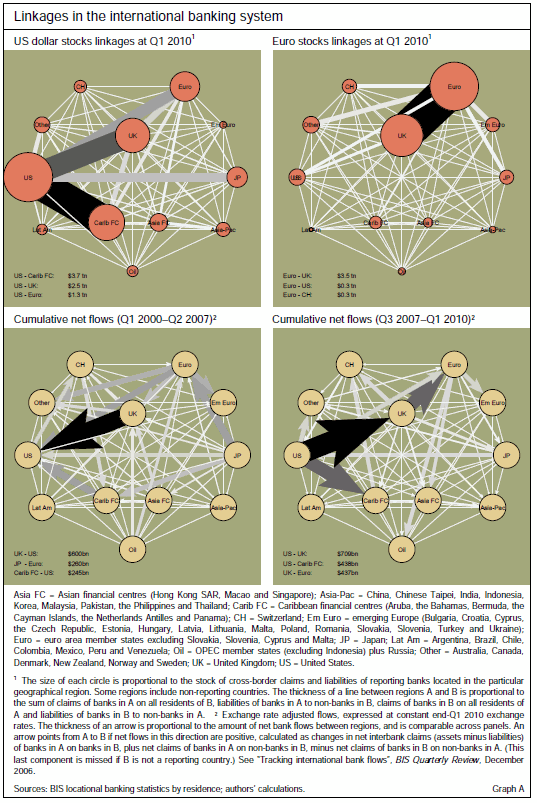
One answer may be found by examining the network dynamics embedded in the international banking system, one representation of which is above. (This graphs in-degree, which are bank holdings from country i to country j. Tie strength is the amount of holdings, node size is cumulative in-degree from all countries in the network.) The international banking network is highly unequal, with the US as the most central node in the system. Highly unequal networks have different dynamics than other networks, one of which is a "preferential attachment" rule for organizing links between nodes. The rule states that, because of network externalities, nodes that attract a lot of links will tend to attract even more links in the future. Thus, the structure of the network is stable and self-reinforcing.

The US has attracted by far the most foreign bank holdings throughout the entire data series, and the intensity of these links has increased (in nominal terms) over time. That process hesitated briefly at the height of the financial crisis before resuming. So given the structure of the network and the dynamics that that structure implies, increased flows into the US -- especially during times of trouble like those currently plaguing Europe -- is exactly what we should expect. If we didn't continue to see this behavior that's when we would need to start looking for major changes to the organization of the global economy.

Saturday, February 5, 2011

Why Optimal FinReg Isn't Even on the Table

. Saturday, February 5, 2011
0 comments

Here's a nice little illustration of the difference between technological desires and political realities in financial regulation:

What is the optimal level of capital that a bank should hold? The new Basel III agreement sets a minimum level of 7% core Tier 1 capital, whose definition has been sufficiently tightened to consist almost largely of common equity. Under the Basel II rules, a bank could get away with just 2% common equity. But if Bank of England Monetary Policy Committee member David Miles is to be believed, regulators should really be forcing banks to hold as much as 20% core Tier 1 capital.


Miles, in other words, wants a 500% increase from Basel I and II in the amount of Tier 1 capital banks would have to hold. And maybe he's right: maybe that is the right amount. But that's basically irrelevant:

The Basel Committee calculated that just raising core Tier 1 capital ratios to 7% would require the world's 94 biggest banks to raise €600 billion ($821 billion) of equity, based on December 2009 balance sheets. If U.K. banks had to raise capital ratios to 17%, they would need an extra £757 billion ($1.2 trillion), more than twice their current market capitalization, according to UBS.


That is probably impossible in the current environment. As the article notes, Modigliani-Miller posits equivalence between debt and equity in the long run, but we're very much in the short run.

There's also a nice bit about the relationship between government policy and market expectations, and the political controversies over a supposedly technocratic policy.

As regulators have learned with Basel III, it doesn't matter how long banks are given to transition to higher capital requirements, the market will hold them to the higher standard straight away, a process known as superequivalence.

Still, Mr. Miles's analysis is useful in one respect; it shows the clear direction of thinking in U.K. official circles. British policy makers pushed hard in Basel for a minimum core Tier 1 ratio of 10%, supported by the U.S. and Switzerland. They are now winning support on the Financial Stability Board, which is overseeing the global overhaul effort, that the proposed additional capital buffer for too-big-to-fail banks should take the form of common equity. The U.K.'s Independent Commission on Banking also is considering further capital requirements for British banks over and above anything Basel demands.

Saturday, January 1, 2011

Dodd-Frank: The Good Stuff

. Saturday, January 1, 2011
0 comments

Economics of Contempt has a wonderful two-post series on the importance of resolution authority for bank regulators. Basically, this means that when a large bank goes under, there needs to be a process in place for dealing with the bank's creditors. Why is this important? He lays it out in part one:

To take one example: Lehman’s holding company (LBHI) filed for bankruptcy, but at the last minute its US broker-dealer (LBI) was kept out of bankruptcy by the NY Fed. The problem was that no one knew about this — most people thought LBI had filed too. Lehman had all sorts of problems getting employees to even show up for work; JPMorgan, which was LBI’s clearing bank, unilaterally shut off LBI’s access to its accounts for several days, and actually started seizing assets of LBI’s prime brokerage clients (a huge no-no); clearinghouses improperly limited LBI’s trading activity; the NSCC mistakenly seized a large amount of LBI’s customer securities; Lehman’s European broker-dealer (LBIE) stopped payments to LBI’s omnibus account even though LBI continued to make payments to LBIE; incoming customer securities to LBI weren’t getting properly segregated; counterparties simply stopped posting collateral they owed on OTC derivatives with LBI; and so on. That first week, the biggest challenge was simply getting someone at Lehman on the phone. (I saw a 63-year-old senior partner do a fist-pump you’d have to see to believe when he finally got an account executive at Lehman on the phone. Unquestionably the highlight of my week.)

You get the picture: it was utter chaos, in no small part due to sheer confusion about what was going on.


He argues that a big reason why Lehman's collapse had such a huge effect on financial markets is that nobody knew what was going on, how much of their money was lost, or even who to call to try to get it back. Given the similar concerns about basically every other Wall Street firm, investors had no idea if their funds were safe, or if/when they'd be repaid if their counterparties went under.

This gets even more complicated when you consider international firms. Which country's creditors get paid, and which get left in the cold? This is part of the ongoing Basel negotiations:

Lehman’s collapse also showed the need for a cross-border mechanism to wind down failing banks that have a global reach. More than 80 proceedings against the firm, involving hundreds of subsidiaries worldwide, have complicated recovery by creditors and destroyed much of the value of its assets.

The Financial Stability Board, which includes most Basel committee members as well as finance ministers from the Group of 20 nations, struggled to come up with such a resolution mechanism this year. The FSB postponed a decision until next year after divisions among nations proved too wide to bridge, members said. The group has been unable to agree on how to distribute losses among countries when a global bank fails and how different legal jurisdictions can recognize a single authority to pay creditors, the members said.


Fortunately, the Dodd-Frank bill gives the U.S. government resolution authority, and there is a similar mechanism in place in the U.K. As Econ of Contempt notes in part two, those are the only two countries that really matter:

What about all those thorny international problems? Well, the truth is that in terms of systemic risk, there’s only one other jurisdiction that really matters: the UK. New York and London are still the two dominant financial centers, and the vast majority of transactions at the major US banks flow through either New York or London. It’s important to understand that it was the UK’s ridiculously backward somewhat dated insolvency regime that forced the liquidators of Lehman’s European broker-dealer to seize so many client assets and assets of affilates. Fortunately, the UK now has their own version of the OLA, which they call the “Special Resolution Regime,” and was enacted as part of the Banking Act of 2009. The Special Resolution Regime is, like the OLA, modeled explicitly on the FDIC resolution authority, and gives the Bank of England the same wide-ranging tools to wind down a London broker-dealer in an orderly fashion — including, significantly, the power to create “bridge banks” to ensure that key functions can continue uninterrupted. Cross-border problems that aren’t identified and dealt with in the resolution plan can, if necessary, be dealt with by bridging the relevant entities until a solution can be fashioned.


I like this line of argument, and I've made the case several times before that basic ignorance was a major problem in the crisis. In my first post on Dodd-Frank I argued that the provisions that increased transparency in the financial system, like resolution authority, were much better than trying to create the perfect regulatory structure that would prevent financial crises from occurring in the first place. The latter approach is sure to fail. The former can do some real good.

I strongly recommend reading both of these posts. They are wonky, but if you are interested at all in what Dodd-Frank did, or why it's important, you'll learn quite a lot.

Friday, December 31, 2010

The Politics of Basel III [2/2]

. Friday, December 31, 2010
0 comments

Yalman Onaran of Bloomberg has a very good rundown of the major issues that remain in the ongoing Basel III negotiations. The headline says "Banks Best Basel" and that's how the article begins, but the story is really about how national regulators can't agree on how to proceed:

The committee’s most significant achievement, members say, an agreement to increase the amount of capital banks need to hold, won’t go into full effect for eight years. Other measures that regulators had hoped would prevent future crises -- liquidity standards, a capital surcharge on the biggest lenders and a global resolution mechanism for failing firms -- were postponed, allowing banks to escape the toughest rules that would force them to change the way they do business.

“There will be changes, but not fundamental changes to the banking model,” said Sheila Bair, who as chairman of the U.S. Federal Deposit Insurance Corp. sits on the Basel committee’s top decision-making body. ...

Banks also reached out to their home regulators, arguing that some rules would disadvantage them more than other nations’ lenders. That helped draw the battle lines inside the Basel committee, according to an account pieced together from interviews with half a dozen members who asked not to be identified because the deliberations aren’t public. Germany, France and Japan led the push for softening rules proposed last December and stretching out their implementation. The U.S., U.K. and Switzerland opposed changes or delays. (bold added)


The bolded portion is a big part of what my dissertation is about*. Other than that, the first thing to note is that, as I've repeatedly said on this blog, major overhauls to the regulatory state are just not in the cards. Basel III is a tweaking of the rules already in place, and as we see below, national governments are under no legal obligation to implement, monitor, or enforce them in toto.

The second important point from this excerpt is that these negotiating coalitions have been in place since Basel I, and it -- once again -- highlights that the popular perception that the U.S. was the home of deregulation while other countries had tougher rules is wrong. Not only is finance (and banking in particular) one of the most regulated industries in the U.S., but U.S. regulations are some of the strictest in the industrialized world. We see that in the Basel negotiations, where the U.S. is pushing for tougher rules, while Germany, France, Japan, and others (sometimes including Canada) want to weaken the regime. Switzerland has already decided that the Basel requirements are too lax, and have unilaterally imposed stronger capital requirements for their banks. The U.S. did this before the financial crisis, under Basel II (which the U.S. -- and many other countries -- never fully implemented).

The U.S. has also had some (very weak) liquidity requirements on the books for decades, something Europe and Japan have not done and resist now:

In addition to pushing for a higher capital ratio, Bair also argued for a global leverage ratio that would cap banks’ borrowing -- something the U.S. has had on its books since the 1980s. In July, when the committee was debating how to define capital, the U.S. agreed to some easing in exchange for Germany and France accepting a leverage ratio, some members said.

Proponents of the leverage ratio, or equity as a percentage of liabilities, say it’s a more straightforward way to prevent lenders from becoming too indebted. Unlike capital ratios, which are based on risk-weighting and can be manipulated, the leverage ratio counts all assets regardless of their risk.


This actually conflates two issues: the liquidity requirements themselves, but more importantly how to define capital. Under Basel III definitions the entire Japanese banking sector is essentially insolvent. In this case the devil is very much in the details. Liquidity requirements are much cruder than many capital definitions, which can be quite complicated and even sketchy, which is why some governments may just refuse to comply:

The EU may exclude the leverage ratio when it converts Basel rules into law next year. Several member nations have advocated dropping the rule, people close to the discussions said last month. A majority of the 27 EU countries oppose adopting the ratio, these people said.


So Basel III is just like Basel I and Basel II: it's about distribution, which means that it's about politics, not technocracy.

*Or what I think it's going to be about. It's still very early days.

Tuesday, October 12, 2010

Policy Preferences over Capital Controls

. Tuesday, October 12, 2010
0 comments

Sebastian Mallaby has a new op-ed in the Financial Times about the difficulty of reversing financial globalization. While that may be true, Mallaby makes some pretty crazy claims on the path to this conclusion.

First, Mallaby suggests that a growing preference for increased capital restrictions among policy makers in US and Europe signals an end to consensus among the richest economies that capital mobility creates growth. By comparing the policy response (and rhetoric) of today to the response to the Asian and Latin American crises of previous decades, Mallaby points out that while the IMF, the US, and the EU pushed capital account openness before, they are now more willing to entertain the idea that capital account openness might be too risky. But, in the past the US and Europe weren't the states having difficultly financing their current account deficits. It makes sense that the US and Europe will now be more open to some measures of capital account restraints since they may want to keep investment from going abroad. And, this policy preference may well be temporary - when macro imbalances are corrected, the US and Europe may be perfectly willing to support unfettered capital account openness once more.

Second, in talking about US animosity towards China, Mallaby offers this policy advice:

Equally, proposals to prevent Chinese capital from flowing into the western economies have a clear appeal. China's peg, and the associated capital exports, distort the world economy; and years of patient diplomacy have failed to resolve the problem. Retaliating against China via trade sanctions would be reckless, since doing so would spread the existing currency war into the trade realm. So why not apply a more proportionate sanction? China already prevents foreigners from buying its bonds, so what is wrong with preventing China from buying US Treasuries? (emphasis added)

Wait, what? The last thing the US wants to do is to cut off a major buyer of its debt!

Rather than characterizing the return of capital controls as an indication that policymakers are moving towards a new consensus on the perils of globalized finance, it may be far more helpful to think about the conditions under which governments will advocate barriers to financial flows.

Finally, while the incentives for making it difficult for domestic capital to exit are pretty straightforward, it is less clear what drives governments to erect barriers to foreign sources of investment. Mallaby mentions Brazil's new tax on foreigners holding domestic securities. What drives these policy choices? Might it be that emerging economies may want to limit the rate of capital inflows since inward investment can easily overwhelm a small economy? If so, would that preclude advanced industrial economies from enacting such barriers?

Friday, September 10, 2010

Only Partially Hopeless

. Friday, September 10, 2010
0 comments

In response to this post, Felix Salmon writes:

Kindred Winecoff, for one, thinks that it’s hopeless to even dream that it might become reality.


If by "dream" Salmon is referring to governments willingly agreeing relinquish control over their domestic financial sectors to an international body that will dispassionately create and enforce a uniform regulatory standard that affects banks in all jurisdictions equally, then he's right: I think it's hopeless to dream that it might become a reality.

But it's not hopeless to dream that the BIS negotiations will yield a framework of rules and guidelines that national regulators will apply to their domestic banking sectors in a way that makes the system safer overall. We just need to understand that there will be some amount of flexibility built into the agreement that allows governments to resolve domestic challenges, which are not the same across all jurisdictions. And we need to understand that regulations made today are unlikely to be sufficient to handle threats to systemic stability 10-12 years from now (these negotiations tend to happen every dozen years or so).

Moreover, the fact that some fragmentation will remain is likely a good thing. Regulations need to reflect the realities of markets being regulated. A truly one-size-fits-all policy is not likely to be successful in its goals, and would almost definitely make international cooperation impossible. We should also keep in mind that the stricter the regulations are, the higher the incentive is to find loopholes and work-arounds. In my view, the biggest problem prior to the crisis was the lack of transparency in the banking system, especially the shadow banking system. Most of the largest, systemically important American banks had large enough capital ratios pre-crash that they probably would have met the new stricter requirements. (Economics of Contempt posted a thorough write-up of this last year.) But a lot of the reason why was because of some accounting tricks and regulatory arbitrage.

I don't want to leave the impression that what's happening in Basel isn't important. I think it is. But I think it's important in different ways that most finance and economics journalists (and even academics) think it is. In other words, I think it's important because of the distributional effects that are likely to emerge from the new agreement, as discussed here and here.

Wednesday, September 8, 2010

More on Basel III Politics

. Wednesday, September 8, 2010
0 comments

In my last Basel post I presented this argument:

It isn't an accident that the firms screaming bloody murder about Basel III are in Germany and Japan, not the U.S. and U.K. That's not to say that U.S. and U.K. banks love it, and they're certainly not going to say it, but Basel III isn't cutting into them as much as some of their foreign competitors.


But I didn't really defend it. Here's what I was talking about:

Big US banks should be able to meet tighter global capital requirements without having to raise substantial amounts of new equity, according to calculations by Barclays Capital. ...

BarCap, for example, estimates that the 35 largest US bank holding companies will need to come up with $115bn in new equity or retained earnings to bring the ratio of their equity tier one capital to risk-weighted assets – a key measure of financial strength – to 8 per cent under the revised rules.

That is about half the $225bn in new capital the biggest US banks would have had to raise under a tougher draft of the rules circulated in December, said BarCap’s Tom McGuire, whose unit did the calculations.

Similarly, Nomura analyst Jon Peace calculated that the top 16 European banks would need to raise €200bn ($257bn) to restore capital removed by the reforms, down from €300bn under the December rules.


That was written before the new estimates came out, which are somewhat stiffer than those mentioned in that article, but that would likely hurt European banks even more. Here's why:

Germany’s top 10 banks will have to raise as much as €105bn ($135bn) of fresh capital under a global regulatory overhaul, the country’s banking industry has warned, in a last-ditch effort to change tough new rules. ...

The reforms are particularly contentious for German banks because public sector groups in particular have relied strongly on instruments called silent participations, which are not loss-absorbing, making them unsuitable as top-quality capital in the eyes of the Basel committee. ...

In July, when a draft was published, Germany was alone among the 27 countries represented in saying it could not agree to tighter definitions of capital without knowing what the headline ratios would be.


Notice that under these projections the top 10 German banks would need to raise $20bn more than the top 35 American banks. The headline ratios now appear to be tougher than what they were expected to be in July. In other words, German banks are even worse off than what they probably expected just two months ago. This is a huge benefit for U.S. firms. Factor into that the new liquidity requirements -- which will hit U.K. firms much harder than U.S. firms because U.K. firms had levered-up much more than even American firms -- and the fact that the Japanese banking sector is basically insolvent by rumored Basel III definitions, and the entire Basel agreement gives American firms a huge competitive edge.

Japanese banks are particularly unhappy that under Basel III, deferred-tax assets would no longer be able to count as Tier 1 capital. ...

The tax deferral tactic started losing favor after Resona bank had to be nationalized in 2003 when its auditor wouldn't sign off on tax deferrals and its capital adequacy fell too low. Still, in 2008 roughly 100 banks counted as assets tax deferrals equal to 20% or more of their core capital, according to a Bank of Japan survey last September. The numbers had been rising for two consecutive years. In the U.S., by comparison, the Fed lets banks count the lower of either tax deferrals realized in one year or 10% of core capital.

A bigger factor, though, may be that Japanese banks have so much trouble raising any other kind of capital. Retained earnings are out because their profits are among the lowest in the world on either a return-on-equity or return-on-assets basis, according to a Bank of Japan report last month.


This is why Geithner, Bernanke, and the Obama team left capital requirements out of FinReg. They knew that a unilateral move to stricter standards would hurt American firms, while an international move would help them. Geithner believes (and I agree) that the only financial regulations that are truly essential are capital ratios. So they saved the biggest piece for last in the hopes of dumping off some of the costs of re-regulation onto foreign firms. And it looks like they succeeded.

As I said before, this isn't just about making the system safer. It's about making someone else pay to make the system safer.

Tuesday, September 7, 2010

Basel Is About Politics, Not Technocracy

. Tuesday, September 7, 2010
1 comments


Felix Salmon makes a big mistake:

And while the emerging markets are no strangers to banking crises, the fact is that the most dangerous such crises are always the ones which take place in large, mature economies.

That’s where regulators — by which I mean the Bank for International Settlements, in Basel — have to step in, by forcing all countries to adopt a bare minimum capital requirement which will protect the system in two main ways: it will make bank failures less likely and less frequent, and it will improve the ability of the rest of the system to withstand any bank failure which does still occur.


What's the problem? The BIS is not a regulatory body. It has no statutory authority. The BIS is a talk shop, a place for national regulators (mostly central bankers) to periodically meet and discuss changes in the international financial system, and occasionally hammer out a non-binding, unmonitored, non-enforced agreement. The BIS does a bit of data collecting and dissemination, but that's about it. They can't "force" states to do anything.

This is on purpose. Politicians use regulatory policy to address domestic political concerns, which is why there is a high level of cross-national regulatory divergence despite the fact that the Basel framework has been in place for over two decades. One example is universal vs. split banking systems. In Europe, banks have generally been allowed to participate in investment and commercial banking simultaneously. In the United States, this was not the case until the repeal of Glass-Steagall in 1999, and the Volcker Rule in FinReg partially reinstates that separation. Other differences include varying definitions of regulatory capital as well as how much capital banks must hold[1]. There are many other cross-national variations in regulatory policy, including accounting risk-measurement standards. All of these reflect differences in local banking sectors, which lead to different domestic political incentives. Politicians won't give up their domestic authority or ability to address changing local circumstances, so agreements made in Basel are subject to interpretation, implementation, and enforcement by domestic regulators. The U.S. still hasn't come into full compliance with Basel II, for example, and there is essentially no recourse for other nations or the BIS to force it to do so.

The Basel negotiations periodically occur when one or two leading states become concerned that their firms must take inordinate risks to be competitive in globalized markets. When this risk-taking leads to a crash, or government intervention to prevent a crash, these states seek an international agreement in order to sufficiently protect their firms from some of that competition, thereby reducing the need for as much risk-taking. It isn't a coincidence that the three major instances of Basel negotiations followed periods where increased competition lead to more risk-taking by American (and some European, esp. U.K.) firms, which then lead to a crash or near-crash when some of the bets didn't pay off. The first followed the Latin American debt crisis, the second followed the Asian financial crisis, and the third followed the subprime crisis.

The leading states use these crises to reorganize international markets in ways that protect their firms. Bailing out banks with public funds is obviously extremely unpopular with voters, but causing firms to lose business to less-regulated (or more state-supported) foreign competitors is extremely unpopular with the financial sectors and their employees. Pushing some of the costs of moving to a more regulated system onto foreign firms is one way that powerful states can resolve a domestic political tradeoff.

Thomas and I have a paper about this, about which hopefully more soon, and this general question is what my dissertation is about[2]. I also hope to have more to say about the specifics of the Basel deal as time permits and details emerge. In other words, you'll probably be hearing a good bit more from me about this topic in coming weeks and months.

But this is exactly what I was talking about when I criticized journalists for not knowing more about political science. Not to pick too much on Salmon, who I think is a phenomenal reporter and generally a force for good in the world, but here is a major international negotiation taking place between the most powerful states in the world, and almost everyone is treating it like it's a technocratic problem. It isn't. It's a political problem, and it can only be understood in that context. No one would write about the START treaty this way.

It isn't an accident that the firms screaming bloody murder about Basel III are in Germany and Japan, not the U.S. and U.K. That's not to say that U.S. and U.K. banks love it, and they're certainly not going to say it, but Basel III isn't cutting into them as much as some of their foreign competitors.

Like I said, hopefully more about our paper soon. In the meantime, one of Thomas' previous papers (with Rob Nabors) about the politics of Basel I provides a good framework for thinking about the politics of Basel III.

[1]There is considerable cross-national divergence above the current Basel minimum; the U.S., for instance, has required a 6% Tier 1 ratio and 10% Tier 1 + Tier 2 ratio to be considered "well capitalized". These were 50% and 25% higher than the required Basel minima, respectively. People tend to be very surprised that, historically, the U.S. has tended to have stricter banking regulations than Europe, but it is the case.

[2]The dissertation is still in the planning stages, so I won't make any claims for it yet.

UPDATE: Since Salmon pointed some traffic here, I edited slightly for clarity/poor writing. No substantive changes made.

Saturday, March 27, 2010

Sanctions, Sovereign Borrowing and Financial Integration

. Saturday, March 27, 2010
9 comments

Over the last couple of months, Sarah, Will and I have been working on our MA theses, each hoping to make a sufficiently important contribution to the discipline (or at least show sufficient potential to some day contribute something) to warrant the department to continue funding us and let us start studying for comprehensive exams and work on our dissertation proposals. I'm writing my thesis on the intersection between economic sanctions and finance, specifically how financial integration and sovereign borrowing affects a target state's decision to acquiesce to sender demands in high politics cases.


Earlier this afternoon, I stumbled upon an article titled "Don't Sanction Dictators" by Jason McLure that was published in Foreign Policy last summer that has a bit in common with the argument I'm trying to advance. In the piece, McLure argues that sanctioning dictators is a futile policy choice for advanced countries and uses the threatened sanctions against Eritrea as he makes his case. McLure argues:
Sanctions are made to cut countries off from vital international exchange. The trouble is, Eritrea already trades less with the outside world than any country in Africa and places 210th out of all 226 countries and islands for global commerce.
He then discusses the specific case of Eritrea and how sanctions against dictators won't work because they won't respond to the coercive attempts of larger states and concludes:
These lessons apply to sanctions on dictators more broadly. How do you punish North Korea with sanctions when its trading partners are already limited to a handful of countries -- none of which are likely to pay heed to a harsher set of rules? How do you choke Zimbabwe's Robert Mugabe when his strongest rationale for staying in power is to save his country from the hands of countries who would (and do) impose sanctions? Perhaps it's no wonder that such countries' leaders not only survive sanctions, but use them to justify bad behavior.
I'm really happy to see McLure make this argument, and the beginning of his logic is similar to what I am arguing in my thesis. However, McLure stumbles in a couple of ways, specifically when he conflates "international exchange" with trade flows and makes a distinction between autocratic and democratic governments that I argue actually doesn't matter. Analyzing sanctions episodes using a political economy approach, specifically looking at the influences of trade and finance on sanctions success makes a lot of sense and should give our explanations greater traction (at least I hope it does). This is one way in which the extant literature on economic sanctions has been surprisingly weak.

I disagree with McLure and argue that it's not that dictators are better able to withstand the coercive pressure of larger powers simply because of the characteristics of dictatorships, it's the fact that most dictatorships are not intricately linked with the international financial system to the point where larger powers (i.e. the United States) can impose sufficient costs to induce them to cooperate. This characteristic can't be solely attributed to dictators. It's in fact possible for democratic states to have very little integration with global financial markets and thus hold the same financial characteristics that are common in certain autocracies, and you can also have an autocratic government (Singapore) that is heavily integrated with and dependent on financial markets. Furthermore, I object for an array of reasons with immediately relying on trade flows to make an argument for sanctions success without engaging the finance side (if you want to know why, I'll have my thesis up on my website sometime by late April).

Larger powers have very little bargaining leverage over states that are not integrated with and dependent on the international financial system. Why? Because the costs that matter (borrowing costs that are directly imposed on governments, rather than trade costs that are dispersed across the population) can't be unilaterally imposed by these states. They need the cooperation of financial markets, and more specifically institutional investors in order to impose costs on targets. These larger powers need to increase the risk associated with investing in a given country, which increases the borrowing costs of the target state as investors seek higher interest rates and/or decrease exposure to that market in order to compensate for the increased risk. A credible threat to act if a government does not change its policy coupled with the effects (or potential effects) of sanctions themselves are sufficient to induce an increase in a target government's risk profile.

Institutional investors can only impose costs on states that require foreign capital to continue to finance their international debt obligations, roll over their debt and fund their operations. Those that are not sufficiently integrated and not dependent on global markets for access to capital will have dramatically lower costs when engaging in sanctionable (risky) behavior because they don't have to worry about increases in borrowing costs when calculating the costs and benefits of a given policy bundle. It is not that states with one type of political regime or another are better able to withstand coercive pressure from advanced, industrial countries, it's the fact that those states that are dependent on external sources of financing have the most to lose from engaging in that activity and can't withstand the coercive pressure. Non-integrated and non-debt dependent states' individual cost-benefit analyses are not sufficiently altered by sanctions threats or impositions and thus the costs associated with defecting from the status quo are very low. Therefore, sanctions episode success should be based on two indicators: 1) a country's degree of financial integration and 2) it's external debt to GDP ratio. Or at least I hope it is so that my thesis committee will find it in their hearts to pass me!

Saturday, October 24, 2009

How to Improve Regulation

. Saturday, October 24, 2009
0 comments

Martin Wolf has a good column on the difficulties of crafting an appropriate regulatory structure. Basically, he says, in order to get a truly safe system we have to abolish banking. Despite recent difficulties, that isn't desirable. So he offers an outline for how improve the system without destroying it:

First, create a set of laws and institutions that make it possible to bankrupt any and all institutions, even in a crisis. Second, make financial institutions safer, with much higher capital requirements, against all activities. Third, prevent off-balance-sheet activities. Fourth, impose dynamic provisioning. Fifth, require huge cushions of contingent capital. Finally, cease to favour debt-finance, throughout the economy.


Kevin Drum is on board:

This is very sensible sounding: the first item is a backstop in case the others don't work, and four of the remaining five items are aimed at reducing leverage throughout the banking system. (Dynamic provisioning is the exception. It might be a good idea, but it's not directly related to reducing leverage.) Now extend this to the rest of the financial system and make sure to write the rules with no wiggle room, and you're done. Piece of cake, really. Any other problems you'd like solved?


But Matthew Yglesias sees trouble:

I’m not sure how much of this can stick in an industry where the product and the inputs (just money, really) can cross international borders so easily. Shut down some antics in London and they move to Zurich.


I'm on board with some of Wolf's ideas. The first is a clear priority; indeed, one of the reasons why the financial crisis was so bad that it threatened to kill the entire global economy is because Paulson and Geithner had no way to wind down troubled firms in an orderly fashion. Markets panicked as half the financial industry was in a state of flux, and an old-fashioned bank run was on. (For a good description of this, see this excerpt from Andrew Ross Sorkin's new book.) It wasn't that banks were too big too fail per se. It was that there was no legal way for them to fail in a timely, ordered fashion. So Paulson and Geithner had to try to find buyers for the troubled firms, transform investment banks into bank-holding corporations to get access to loans from the Fed, and try other ad hoc "fixes" to prevent total collapse.

I am similarly in agreement with Wolf that all bank activities should be "on balance sheet". A lack of transparency was a major problem in this crisis, and part of the reason was that nobody knew what obligations what banks actually had. And this includes the bankers themselves, not to mention traders, hedge funds, short sellers, etc. Any regulation that improves transparency in the financial system is a good one, if you ask me.

But contra Drum, I'm not sure what good the other provisions would have done in this crisis. All of the banks were more than well-capitalized, even Lehman. Merrill Lynch had $140bn in cash that dissipated in about a week because of withdrawals when they were fundamentally solvent. Most banks had Tier 1 ratios more than double their Basel requirements and overall capital ratios were similarly high. Bank runs caused illiquid firms to become insolvent, and chaos ensued because there was no way to wind them down.

There were two primary problems in this crisis: mispriced risk, and massive amounts of uncertainty that led to a panic. Wolf's proposals don't address the risk part, and once a panic sets in a bank is doomed no matter how much capital they hold in reserve. Moreover, one reason why banks were levered up so high was because of the risk-weighting scheme in Basel that, combined with the Recourse Rule, encouraged banks to invest in asset-backed securities. If we require higher capital requirements under a similar risk-weighting rule we'll be essentially encouraging even more leverage.

Yglesias' response is similarly misguided. The problem wasn't regulatory competition. Indeed, the U.S. has higher capital requirements than many other Western countries, yet that didn't matter to anyone. (Additionally, whatever the U.S. does generally becomes a widely-adopted international industry "best practice" standard.)

I would add one thing to Wolf's list: make it easier to declare "bank holidays" on part or all of the banking system. It now seems clear that excessive short-selling made the crisis much worse than it needed to be. Also, most of the work by Paulson, Bernanke, Geithner, and private firms had to be done over weekends while the markets were closed. If Bernanke and Paulson could have declared a week-long holiday + ban on short-selling the day that Lehman collapsed, and used that time to come up with permanent solutions, much agony might have been avoided. Same if they could have conducted "stress tests" or determined which banks could survive and which couldn't without markets reacting to every drop of sweat on Paulson's brow.

Monday, October 5, 2009

More on the Tobin Tax

. Monday, October 5, 2009
0 comments

One of the bloggers at From Davos to Seattle thought I was too harsh on the Tobin Tax last week:

[W]hile the Tobin Tax is certainly not ‘the answer’, it might well be an answer. At the least, it has the potential to become a progressive and effective tool in global economic governance. The strange thing is that however much it might irk the city and financial institutions, the Tobin Tax is an idea that never quite seems to go away. Its simplicity and elegance, together with the fact that it’s not a tax that (directly) impacts much on the ordinary citizen make it perennially popular. One gets the feeling that however much structural power is wielded by those who stand to lose by it, every idea that manages to be both good and popular at the same time will have its time come eventually.


More specifically, the post argues that it doesn't matter if the two given goals of the Tobin tax are in contention (as I claimed), because the primary point is to limit hot money flows in and out of the developing world. Any revenue raised by the tax would be a nice bonus, especially if that cash is given to an international organization for global redistribution (potentially making it a progressive, not regressive, tax), but is not required.

Last part first: no way is that going to happen. Developed countries aren't even living up to their Millenium Development aid promises, and sovereign debt has exploded since the onset of the financial crisis and ensuing recession. These governments are not going to agree to tax investment into their countries and then redistribute the proceeds to poorer countries.

More importantly, if we want to limit hot money flows (and esp. mitigate their negative consequences, like pressures on exchange rates), aren't there ways of doing that more directly? We could institute capital "curfews" that prevent investors from pulling money out of a country during a panic. Indeed, this was advocated during the Asian financial crisis, put in place in Malaysia, and is now part of the IMF's program. Or we could require minimum investment periods upfront as a condition of large financial investment in LDCs, so investors know they cannot prematurely withdraw their funds without steep penalties. All capital controls have their downsides, but at least these would be attacking the problem directly.

Not that that has much of anything to do with our current crisis and recovery. Even proponents of the Tobin tax (like Rodrik) do not imagine that a Tobin tax would have made our present circumstance less dire. Neither would a Tobin tax actually protect countries from exchange rate pressures from capital flight unless it was very large.

So what's the point? What can a Tobin tax do that other, more direct, capital controls cannot do? Perhaps it is more politically palatable than stricter capital controls, but given that the Tobin tax has yet to be tried despite its "simplicity and elegance" (I thought those were derogatory words in economics these days?), that argument doesn't persuade me either. I just don't see the value-added of a Tobin tax relative to the policy options already in our toolkit.

Saturday, September 26, 2009

Rogoff on International Financial Regulation

. Saturday, September 26, 2009
0 comments

He doesn't think executive compensation is the main problem:

[T]here's no one-size-fits-all solution. It's hard not to be sympathetic to that, and clearly we've shown that a lot of the financial firms are effectively public entities with trillions of dollars of cash at their disposal. On the other hand, it's sobering to note that the European banks, by and large, did not have these huge, American-size payouts. Yet they managed to get themselves into just as much trouble. The short-term borrowing is the real problem.


By "short-term borrowing" he really means huge leverage ratios that require banks to roll over their entire net worth many times per month. When credit is flowing, that's not a problem. When it isn't, we get the Great Financial Meltdown of 2008. Along similar lines, Rogoff also wants higher capital requirements, particularly for short-term borrowing by banks. In other words, Rogoff sees the problem as fundamental to the structure of banking: banks borrow short and lend long. He's right, but that feature will always be with us. The trick is figuring out how to limit the systemic risk.

Rogoff also has thoughts on the difficulties of international harmonization:

Also, the undercurrent is the United States makes a lot of money off of international finance. It's a big profit center -- we are the winners, and we want to keep the system. The rest of the world says, "But you're generating risk." We have a very different agenda from, say, Germany or France. They will have much less to lose by strengthening regulation because they have much stronger regulation to start with.


It's not just the U.S.: the U.K. and Japan also make a lot of money from finance, and Japan in particular does not seem interested in jacking up capital requirements. Nor is it clear that that would have prevented this crisis or would prevent the next one. Indeed, stricter capital requirements in Basel incentivized banks to take on more securitized loans since those had a lower risk-rating than the unsecuritized debt banks were previously holding.

International Political Economy at the University of North Carolina: international finance
 

PageRank

SiteMeter

Technorati

Add to Technorati Favorites